- Tea bag packers need a controlled cut size, a steady bulk density, low dust and low moisture, because each affects fill weight and machine speed.
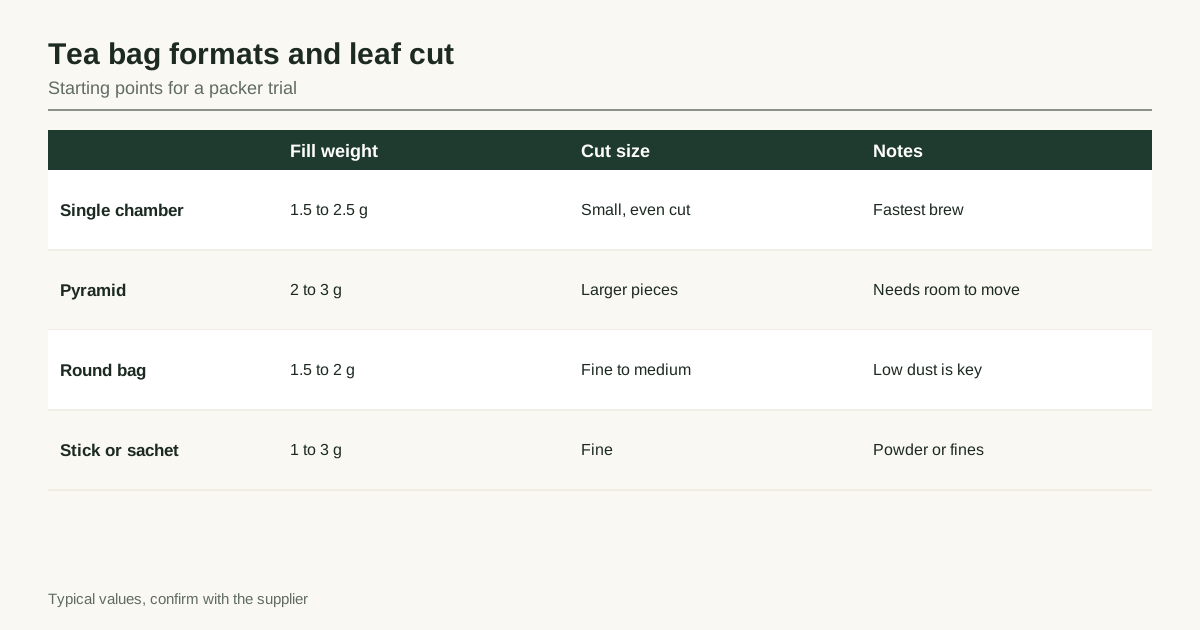
- Bag format decides the cut. Flat bags run on small even pieces, while pyramid bags need larger leaf with room to open.
- Trial the exact lot on your machine and record fill weight variation before you sign a volume contract.
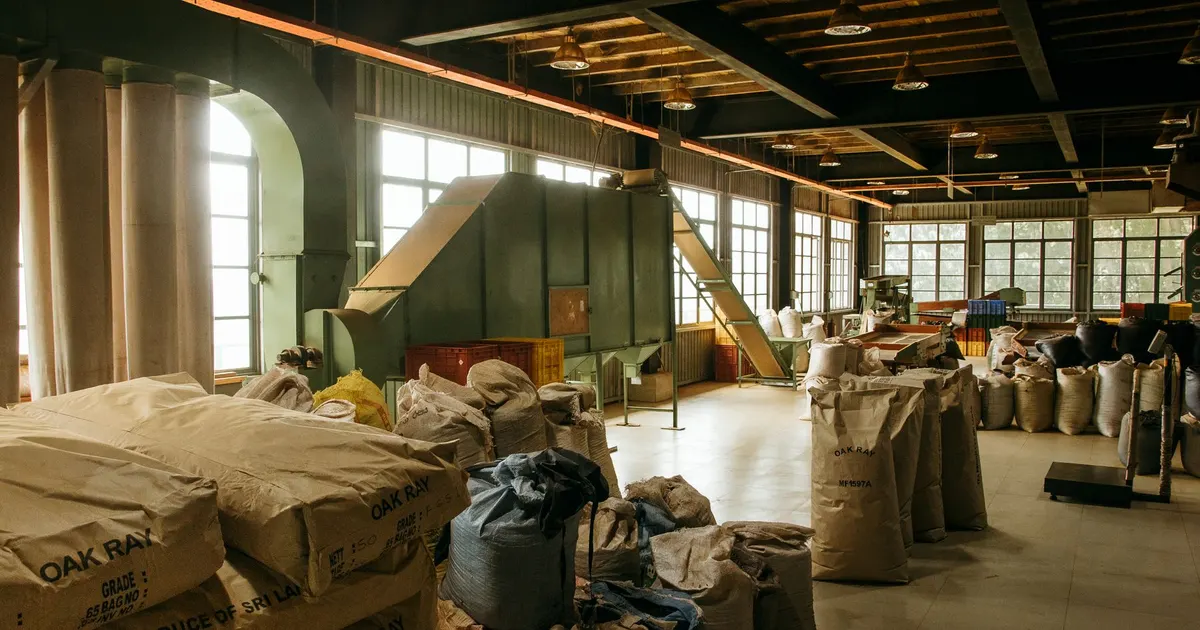
Tea bag packers live and die by consistency. A line that runs thousands of bags an hour needs tea that flows evenly, fills to weight and does not clog the machine. Tea that varies from sack to sack costs time, waste and complaints. When you buy bulk green tea for bags from Vietnam, the details that matter most are rarely flavor alone. They are cut size, bulk density, dust and moisture. Each is easy to measure, easy to write down and easy to forget.
This guide is for packers, private-label brands and co-packers. It explains how the physical properties of bulk tea affect bag filling, how to specify them and how to test a sample. The numbers are typical starting points. Your machine and your product team set the real targets.
Start with the bag format
Bag format decides what tea you need. Common formats include:
- Single-chamber flat bags. The standard two-sided paper or nonwoven bag. These need small, even pieces that pass through the filter paper pores, and a cut that fills the bag without bridging.
- Pyramid or tetrahedral bags. Larger mesh bags that give leaf room to open. They use larger cuts, often broken leaf or small whole leaf pieces.
- Round bags. Circular bags, often in a nonwoven fabric, used with medium cuts.
- Stick or sachet formats. Powder or fine fannings.
Choose the format first, then work out the cut. Our private label guide covers bag formats and typical minimums.
Cut size
Cut size is the size of the pieces in the bulk tea. For flat bags, a fine, even cut is typical. Pieces that are too large clog the filling mechanism or poke through the paper. Pieces that are too small leak dust. A size window defined by mesh is the right way to set it. For example, a spec might require that most of the lot passes one sieve and stays on a finer one, with strict limits on oversize and on fines. Your machine supplier can often suggest a window that has worked for similar products.
Whole-leaf pieces for pyramid bags need a coarser window. If the pieces are too fine, the benefit of the bag format is lost, since the tea has no room to open and the cup tastes the same as a flat bag.
A sieve analysis of the sample lot tells you how much tea falls in each size band. Ask the supplier for one. Run your own on arrival, with the same sieves, and compare.
Bulk density
Bulk density is the weight of the tea per unit volume when it is poured loosely. Filling machines usually measure tea by volume, using a cup or a screw, so bulk density directly sets the weight in each bag. A denser tea gives a heavier bag at the same setting, and a lighter tea gives a lighter bag.
Density depends on leaf shape and size and on moisture. Twisted pan-fired leaf, flat steamed pieces and fine fannings all pack differently. Typical bulk densities for cut tea vary over a wide range, and your machine will have a window that works. Write the target density into the spec with a tolerance, and state how it is measured, for example loose-poured into a cup of known volume and weighed. Check density on every lot. If it drifts, fill weight drifts with it.
Dust and fines
Fines are fine particles that pass through the sieve. A small amount is unavoidable. Too much causes problems: dust leaks through the bag paper and stains the carton, collects on the machine, clouds the cup and shortens machine life. For tea bags, a limit on fines is one of the most important specs.
Ask the supplier to sieve out dust before packing and to describe how they handle the fine fraction. Ask them to avoid rough handling during bagging and loading, since dust forms when tea is tipped or dropped. Ask for packing in strong sacks with a liner so dust does not escape in transit.
Stalk and foreign matter
Stalk is pale, stiff and bitter, and it can pierce bag paper. Write a maximum stalk percentage into the spec. For foreign matter, ask for a limit and a description of the checks at the factory, such as metal detection, magnets and visual inspection. If your own line has a metal detector, tell the supplier. Factories remove stalk with static or roller machines and check for metal with magnets or detectors.
Moisture
Dry tea flows better and keeps better. High moisture makes particles stick, which causes bridging in the hopper and uneven fill. It also shortens shelf life. A typical maximum for bag tea is 6 to 7 percent, measured by a stated method. Ask for the result on every lot and check it on arrival.
Color and taste
Tea bag customers judge color and taste first, so the physical specs sit alongside sensory ones. Agree a type sample that sets the color of the dry leaf, the color of the liquor and the taste at a standard brew. Define the brew: dose, water temperature and time. Compare each lot against the sealed type sample before packing.
Summary of specs by bag format
| Spec | Flat bag | Pyramid bag |
|---|---|---|
| Cut | Small, even | Larger pieces |
| Fill weight | About 1.5 to 2.5 g | About 2 to 3 g |
| Fines | Strict limit | Moderate limit |
| Stalk | Strict limit | Strict limit |
| Density | Tight tolerance | Wider tolerance |
| Moisture | 6 to 7 percent maximum | 6 to 7 percent maximum |
Packing and shipping bulk tea
Bulk tea normally ships in foil-lined or plastic-lined paper sacks of 25 to 50 kg, or in cartons with a liner. A 20 ft container holds roughly 18 metric tons of bulk tea, depending on density and packing. Sacks should carry a lot number, a net weight and the production date. Ask the supplier how the sacks are sealed and how the pallets are wrapped. Use desiccant and liners in the container during humid seasons.
Testing a sample on your machine
Ask for at least a few kilograms of the exact lot, not a 100 g sample. Run it on your packing machine at normal speed. Record how it flows in the hopper, whether it bridges, the fill weight of a hundred bags and the spread, the amount of dust on the machine after a run and the appearance of the filled bags. Brew bags from the run and compare with your current product. If the fill weight spread is wide, check density and size window. Share the numbers with the supplier. Suppliers can often adjust sieving or blending to fix a specific issue if they have data.
Blending lots for steady supply
A packer that runs all year will receive tea from several lots, and each lot differs a little. Good suppliers blend lots to a target before packing, so that cut, density, color and taste stay within a narrow band. Ask whether the supplier blends in a mixing drum, how many sacks go into each blend and how they sample the blend afterwards. Ask for a blend record that lists the source lots and their weights. If the supplier ships unblended lots, expect more variation, and plan to check each one on arrival. For long contracts, agree the tolerance for each spec line in writing, and agree what happens when a lot falls outside it.
Transit, handling and storage at the packer
Dust and breakage rise with every handling step. Sacks that are thrown, dropped or stacked too high can crush leaf and create fines. Ask the supplier to palletize and shrink-wrap sacks and to load the container with care. At your plant, store sacks on pallets away from walls and floors, in a cool, dry and odor-free area. Open sacks only when needed and reseal them. Keep a first-in, first-out record by lot number, so that if a problem appears in finished bags you can trace it back to a single sack.
Cost drivers for bag-grade tea
Bag-grade tea is priced largely on grade, size window and compliance. A tighter size window costs more, since it needs more sieving and gives more of the lot to other grades. A very low dust limit costs more for the same reason. Residue-tested lots cost more than untested ones. Large lots of one blend cost less per kilo than many small ones. Our price guide explains how these parts add up. When comparing quotes, put each quote against the same size window, the same fines and stalk limits, the same moisture limit and the same packing, otherwise the numbers are not comparable.
Questions to ask suppliers
Ask which sieves they use and what the size window is for each grade. Ask whether they cut the leaf or use sorted fractions. Ask for bulk density figures. Ask how they remove dust. Ask whether they can blend lots to a steady density and cut. Ask how many tons per month they can supply in the same specification. Ask for their moisture and residue results by lot.
Related reference
See also ISO 11286 and how to write a sieve line.
Next step
Write the bag format, the size window, the density range, the fines and stalk limits and the moisture maximum into a spec. Then send it through the RFQ form. We introduce up to 3 matched Vietnamese suppliers within 24 business hours, and you then agree trial lots with them directly. Our specification guide shows a full layout. For how bag cut compares with other end uses, read our guide to bulk green tea.
Frequently asked questions
What fill weight should I plan for?
Single-chamber bags often hold about 1.5 to 2.5 g of green tea and pyramid bags about 2 to 3 g, though brands choose their own. Settle the weight with your product team, then specify the cut and density that deliver it.
Why does bulk density matter?
Machines fill by volume, so a denser tea gives a heavier bag. If density varies between lots, fill weight drifts. A written density range keeps weight steady and avoids constant machine adjustment.
How do I reduce dust in my bags?
Specify a limit on fines, ask the supplier to sieve out dust before packing, and handle sacks gently. Dust leaks through paper and clouds the cup, and it collects on machine parts.