- Black tea dominates Middle East tea drinking, while green tea is a smaller but active segment in retail, cafes and health lines.
- Entry depends on destination rules: label language, food registration, certificate legalization and shelf life on arrival all vary by country.
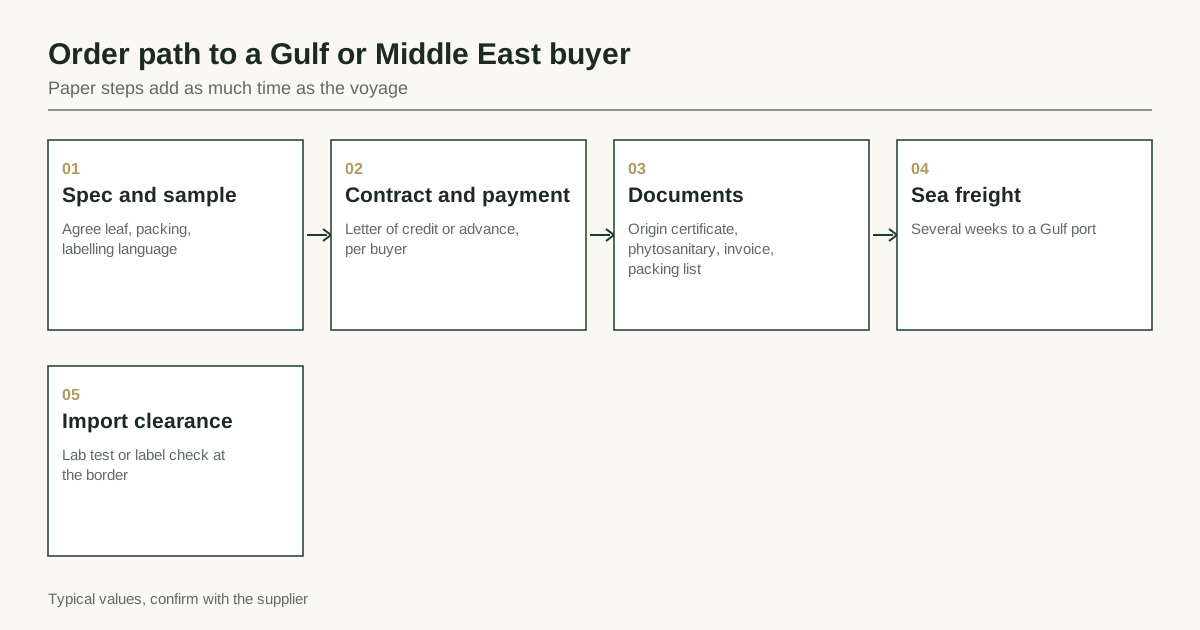
- Sea freight takes weeks, and the paper steps can take as long. Build documents and clearance time into the plan.
The Middle East is a large and long-established tea market. Tea is part of daily life from the Gulf to the Levant, and importers in the region buy tea in very large volumes. Most of it is black tea. Green tea is a smaller segment, but it has a steady base of buyers in retail, cafes, the health and wellness segment and some traditional uses. For Vietnamese green tea, the region is a realistic target when the buyer knows what to ask and the supplier knows what to prepare.
This guide is for importers, distributors and brand owners in the region and for traders who supply it. It covers demand, product choice, labeling, documents, payment and freight. It is general information, not legal advice. Import rules differ by country and change often, so confirm every point with your importer, customs broker or local adviser before you place an order.
Who buys green tea in the region
Several groups buy green tea in the Middle East. Retail brands sell tea bags and loose-leaf packs in supermarkets and specialty shops. Cafes and hotels use green tea for hot drinks and iced tea. Health-focused brands sell green tea and powders for wellness lines. Some buyers blend green tea with mint or other herbs for traditional drinks. Each group wants something slightly different, and a supplier that knows the target segment can offer the right leaf.
Product choices
For retail bags, buyers often want a strong, clear liquor that holds up to long steeping and to sugar and mint. Cut leaf, BOP and fannings work well. For loose retail, twisted or rolled leaf looks good in clear packs and travels well. For hospitality, bulk leaf in large pouches gives value. Powder and extract serve food and supplement makers.
Taste preferences in the region often lean toward strong and sweet drinks. A green tea that tastes mild in a European cup may taste thin in a glass sweetened with sugar. Test samples in the local style, with local brewing habits, before choosing a leaf. Our green tea grades page lists the grades available from Vietnam.
Labeling
Labels are the most common point of difficulty. Many markets in the region require labels in Arabic, either alone or alongside English. Rules typically cover product name, ingredients, net weight, production and expiry dates, country of origin, importer details and storage instructions. Date formats, font size and the placement of text can be specified. Some markets require a halal statement or certification for certain foods, though tea is usually simple, and rules differ by country.
Plan labels early. The supplier needs the text in final form to print packs, and any change after printing costs money. Ask your importer for the exact label requirements in writing and share them with the supplier.
Shelf life on arrival
Some countries require that a minimum share of a product’s shelf life remains when it arrives at port or when it reaches the shelf. If tea has an 18 to 24 month shelf life and spends a month on the water and several weeks in clearance, a lot of life remains, but a lot that was packed long ago may not qualify. Ask the importer for the rule, and ask the supplier for the production date on every lot. Heat in storage also matters, so avoid leaving tea in hot warehouses.
Documents
A typical document set for a sea shipment includes:
- commercial invoice and packing list,
- bill of lading,
- certificate of origin, often needing legalization by a chamber of commerce and sometimes by the destination’s embassy,
- phytosanitary certificate, where required,
- certificate of analysis for the lot, and
- any health or free-sale certificate the destination requests.
Requirements differ by country and by product. Legalization takes time and should be planned from the start. Ask your importer which papers they need, in what format and by which date. Make sure names and addresses match across all documents, since small differences cause clearance delays.
Food registration and testing
Several markets require importers to register food products or obtain import permits before shipments arrive, and some test samples at the border. Tea may be checked for residues, heavy metals, microbiology and labeling. Ask your importer what testing to expect, and ask the supplier for a lot-specific certificate of analysis that matches the likely panel. Our residue guide explains how limits work, and a Middle East importer can tell you which limits apply locally.
Payment
First orders commonly use letters of credit or advance payment. Letters of credit need careful document matching, since a small mismatch can delay payment. Open account terms are usually offered only after trust is built. Whatever terms you agree, put them in the contract, including the currency, the due date and the documents needed to release payment. Some destinations are subject to trade restrictions or banking limits, so check with your bank and a legal adviser before quoting or shipping. Do not ship to a country, bank or party that is restricted.
Freight and timing
Most Vietnamese tea reaches the region by sea. Transit from a Vietnamese port to a main Gulf port usually takes several weeks, depending on the route and the carrier, and transshipment can add time. Allow extra time for loading, export clearance and import clearance. Typical Incoterms are FOB from the Vietnamese port or CIF to the destination port. Heat is a risk in transit and in port storage, so use foil-lined packing, desiccant and, for sensitive lots, shaded storage.
| Step | Typical timing |
|---|---|
| Sample and approval | A few weeks |
| Production and packing | Depends on lot size and season |
| Export documents | Several days to a few weeks |
| Sea freight | Several weeks |
| Import clearance | Days to weeks, depending on testing |
These are rough guides. Confirm each step with the supplier, the forwarder and your importer.
Heat, humidity and packing for the route
Containers bound for the Gulf cross hot seas and sit in hot ports. A steel box in the sun can rise well above ambient temperature, and tea packed with too much moisture will suffer in that heat. Use foil-lined or plastic-lined sacks, keep the moisture within the agreed limit, add desiccant bags and line the container walls. For retail packs, use sealed laminated bags inside strong cartons. Ask the forwarder to book the cargo under deck or away from the engine side where possible, and ask the supplier to photograph the loading, the seal and the container number before the container leaves the factory. On arrival, move the tea quickly to a cool, dry warehouse and check a few sacks for moisture and smell before releasing the lot.
Working with a local importer or distributor
Most buyers in the region work through a local importer or distributor who knows the rules, the customs brokers and the retail channels. Pick a partner who handles the registration, the labels and the clearance, and who has moved food products before. Ask for references from other suppliers, and ask for their view on pricing, pack sizes and brand names that sell. A good local partner can save months by pointing out requirements that a supplier cannot see from Vietnam. Agree who owns each task in writing: label design, text approval, certificate legalization, clearance, delivery and returns. A short responsibility table attached to the contract avoids most misunderstandings.
Brand and private label in the region
Some buyers sell Vietnamese green tea under their own brand. That adds several steps: pack design, Arabic and English text, trademark checks in the destination, printing approval and sometimes a local brand owner registration. Plan these early, since printing and approval can take longer than production of the tea. Keep a sealed sample of the finished pack as a reference, and record the artwork version for each print run. Our private label guide covers formats and minimum quantities from Vietnamese suppliers.
Preparing the first order
Start with a spec that covers the tea, the packing, the label and the documents. Ask for samples in the exact grade and test them with your buyers. Confirm label text and legalization rules. Agree payment and Incoterms. Ask for a pre-shipment sample and a certificate of analysis. Keep a sealed sample from each lot. A small trial order is often the best way to learn the route, before you move to full containers.
Questions to ask a supplier
Ask whether they have shipped tea to the region and which documents they have prepared before. Ask if they can print labels in Arabic and how they handle text proofs. Ask what shelf life they guarantee and what packing they use against heat. Ask how they handle certificate legalization. Ask for references that you can check through your own channels.
Next step
State the segment you sell to, the grade, the pack, the labeling language, the delivery port and the payment terms in one written spec. Then send it through the RFQ form. We introduce up to 3 matched Vietnamese suppliers within 24 business hours, and you then agree samples, documents and terms directly with them.
Frequently asked questions
Which grades sell best in the Middle East?
It depends on the segment. Retail packs often use tea bags or leaf with strong, clear liquor, while hospitality uses bulk leaf. Ask local importers what styles move, and test samples with your target buyers.
Do I need Arabic labels?
Many Middle Eastern markets require labels in Arabic, sometimes with bilingual text. Check the exact rules for each destination with the importer, since content, font size and date formats are often specified.
What payment terms are usual?
Letters of credit and advance payment are common for first orders, with open terms offered later to proven partners. Terms are set between buyer and supplier, and bank rules for each country must be followed.