Home / Tea certificates and market rules
Tea Certificates Buyers Ask For: What Each Proves and How to Check It
Buyers of Vietnamese green tea ask for papers for three different reasons: to show how the tea was grown, to show how the plant is run and to show the lot may enter a market. This page maps the papers to those reasons, says what each one proves and where to check it. The detail pages follow the table. Checked 19 October 2026.
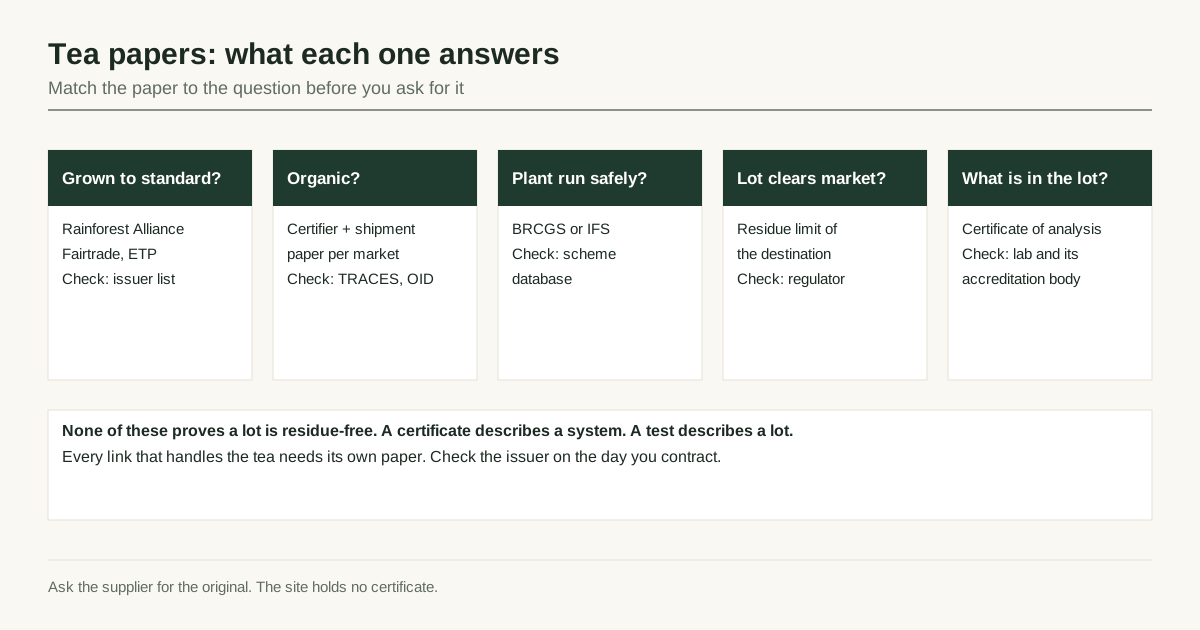
What each paper answers
| Paper | Question it answers | Issued by | Where to check | Detail page |
|---|---|---|---|---|
| Rainforest Alliance farm and supply chain certificates | Was the tea grown and handled to a sustainability standard, and can it be traced | Rainforest Alliance certification bodies | Rainforest Alliance list of certificate holders and the QR code | Rainforest Alliance tea |
| Organic certificate and shipment paper | Is the tea organic for a named market | Certifier, then the market system (TRACES, NOP Import Certificate, JAS route) | Certifier list, TRACES, Organic Integrity Database | Organic tea: EU, USDA, JAS |
| Fairtrade certificate | Were hired workers or small growers covered by the Fairtrade tea standard, and is the buyer a certified trader | Fairtrade certification through FLOCERT | FLOCERT Fairtrade Customer Search, by FLO ID | Fairtrade tea |
| VietGAP certificate | Does the grower or group keep a managed system with records under the Vietnamese crop standard | Certification bodies designated for crop VietGAP | The body and the national accreditation schedules | VietGAP tea |
| BRCGS Food Safety or IFS Food certificate | Is the plant run to an audited food safety standard | Accredited certification bodies | BRCGS Directory, IFS database | BRCGS and IFS at a tea factory |
| Social audit report (SMETA) | Are workers treated lawfully and is the site safe, on the audit date | An audit firm working to the Sedex method, not a certifier | The report itself, its date and scope. Sedex is a platform, not a public register | SMETA at tea factories |
| Ethical Tea Partnership membership | Does the buyer belong to the tea group that shares sourcing site data. It is not a certificate and not an audit | ETP, a membership body for packers, traders and retailers | ETP member list | Ethical Tea Partnership |
| Residue limit for the destination | Will the lot clear on pesticides | The regulator, not a certifier | EU Pesticides Database, Japan MRL database, Korea PLS | EU MRL lookup, Japan, Korea |
| Certificate of analysis | What was measured in this lot | An independent or seller’s laboratory | The lab and its accreditation body | Tea certificate of analysis |
Matrix: product against paper
| Product | Standard to cite | Certificates buyers ask for | Tests and documents | Market rules |
|---|---|---|---|---|
| Orthodox green tea leaf | ISO 11287, cupping | Rainforest Alliance, Fairtrade or ETP on request, organic, VietGAP | Sampling, residue panel, micro, foreign matter, COA | EU MRL lookup, Japan positive list |
| Gunpowder and chunmee for North and West Africa and the Middle East | Export type codes, grade codes, GB/T 14456 | BRCGS or IFS for packers | Foreign matter, moisture | Destination rules |
| Fannings and dust for tea bags | Particle size | BRCGS or IFS | Sieving, micro | EU contaminant limits |
| Powder and matcha-style | Buyer spec | Organic, BRCGS | Micro, heavy metals, particle size | EU, US, Korea |
| Jasmine, lotus and scented | Scenting rules | HACCP | Flavour against flower, residue | EU flavouring labels |
| Organic lots | Organic standards | EU, USDA, JAS organic | Shipment paper checks | EU organic import |
What none of these papers prove
- That the lot is free of residues. A certificate describes a system. Residue is a test on the lot: see the test panel.
- That the lot is the one on the certificate. Match the lot number, bag marks and the transaction record.
- That the certificate is current. Check the issuer’s database on the day you contract.
- That a middleman is covered. Every link that handles the tea needs its own paper.
How to verify any certificate in six lines
- Get the original with the certificate number, name, address, scope and expiry.
- Find the issuer’s database or list. Search by number first, then by name.
- Match name, address and scope to the plant you are buying from.
- Read the scope for the product and the process steps on site.
- Save a dated screenshot.
- Put the number and the validity in the contract.
Market rules in one table
| Market | Limit for a pesticide with no tea limit | System | Page |
|---|---|---|---|
| European Union | 0.01 mg/kg default | Regulation (EC) No 396/2005, EU Pesticides Database | EU MRL lookup |
| Japan | 0.01 ppm uniform limit | Positive list system | Japan positive list |
| Korea | 0.01 mg/kg uniform limit | Positive List System | Korea requirements |
| United States | No tolerance, no residue allowed | EPA tolerances, FDA enforcement | Residue limits guide and FSVP article |
| United States, plant side | Facility registration with FDA, a US agent and the registration number on prior notice | 21 CFR Part 1, Subpart H | FDA registration for a tea exporter |
For the papers that travel with a shipment see tea export documents. For growers and cooperatives preparing a certificate see Rainforest Alliance certification steps for tea farms and the organic conversion period. The test methods and the ISO standards for tea have their own section: see tea standards and test methods. For the supplier side of a plant audit see the factory audit checklist for importers.
A note on this site. greenteavietnam.com does not issue, hold or confirm certificates, and gives no legal advice. Ask the supplier for the original and confirm it with the issuer. We introduce buyers to up to 3 Vietnamese suppliers and the buyer checks the papers. Send a spec through the RFQ form and we reply within 24 business hours.
Frequently asked questions
Which certificate should a tea buyer ask for first?
The one that answers the buyer's own customer. A retailer audit asks for a food safety scheme, a brand claim asks for a sustainability or organic scheme, and a customs check asks for the destination residue limits. Decide the question first and the certificate second.
Does any certificate show that a lot meets the residue limit?
No. Certificates describe a farm, a plant or a system. A residue limit is checked by testing the lot, against the limit of the market where it will be sold.
How do I check a certificate is real?
Ask the supplier for the original, then confirm the number, name, address, scope and expiry in the issuer's own database or list. Each page in this section names the database.
Do you hold any of these certificates?
No. greenteavietnam.com is a matching service. It does not issue, hold or confirm certificates, and each certificate belongs to the farm, plant or company named on it.
Sources
- European Commission: EU Pesticides Database
- Rainforest Alliance knowledge centre: List of certificate holders
- European Commission: Organic farming, trade (import routes and certificate of inspection)
- Consumer Affairs Agency, Japan: Positive list system for agricultural chemical residues
- MFDS, Korea: Positive List System for pesticide residues
Standards and rules are cited as references. They are not claims about greenteavietnam.com or any supplier. Confirm the edition and current status with the issuing body.
Send your spec and the destination market. We pass it to up to 3 Vietnamese suppliers within 24 business hours. Free for buyers.
Send a spec