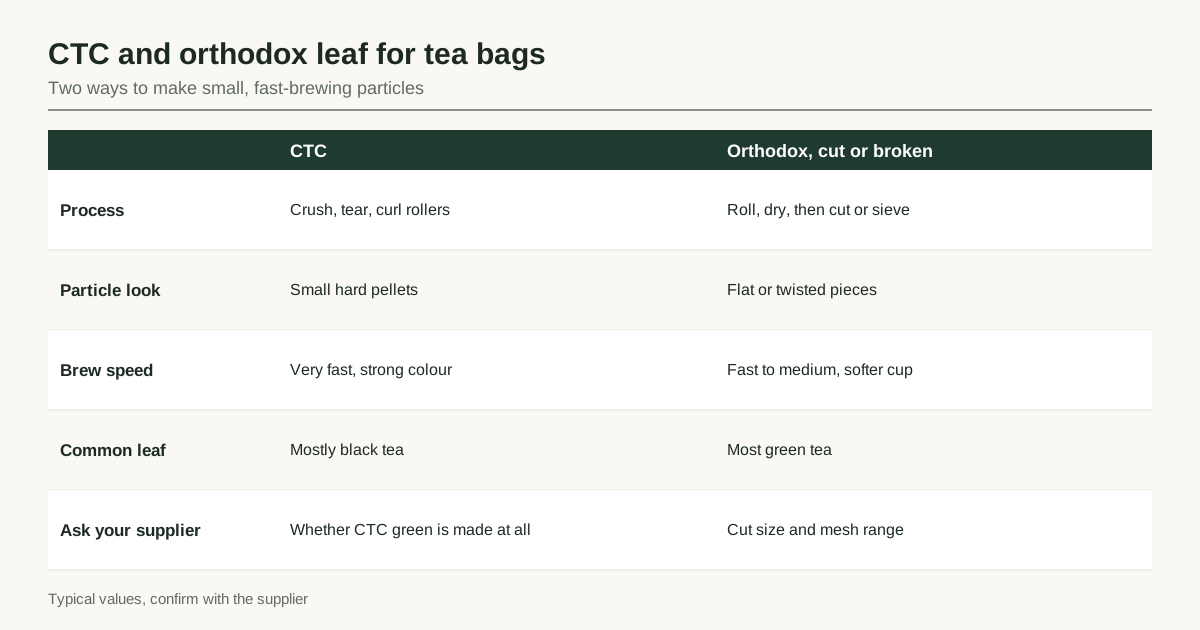
- CTC tea is made by crushing, tearing and curling leaf into small hard granules that brew very fast. Most CTC is black tea, and CTC green tea is a small niche.
- Most Vietnamese green tea for bags is orthodox leaf that is cut or broken to size, not true CTC.
- Ask the supplier how the particles were made, then judge by sieve analysis, brew speed and cup, not by the label alone.

Anyone sourcing tea for bags runs into two terms sooner or later: CTC and orthodox. Black tea buyers use them every day. Green tea buyers meet them less often, and the terms can be confusing when applied to green tea. A clear view of what each one means, and of what Vietnamese factories actually make, can save weeks of back and forth and a lot of unusable samples.
This guide explains the two processes, what each gives in the bag, what is available from Vietnam and how to write the specification. It is written for packers, private-label brands and blenders. The properties described are typical, so confirm them with the supplier on a sample.
What CTC means
CTC stands for crush, tear, curl. In a CTC line, leaf passes between sets of rollers with sharp teeth that crush and tear it into small pieces and then curl those pieces into tiny round or irregular granules. The process breaks cells very thoroughly, so flavor and color release quickly in hot water. The granules are hard, dense and uniform.
CTC was developed for black tea, where it gives a strong, fast-brewing cup suited to bags. That is still where most of it is used. CTC green tea exists, since the same machines can process green leaf in some conditions, but it is a small niche compared with CTC black tea. A buyer expecting a wide market of CTC green tea will find a narrow one.
What orthodox means
Orthodox processing follows the traditional sequence of fixing, rolling, drying and sorting. Rolling shapes leaf into twists, needles or flat pieces, and it is gentler than the CTC rollers. After drying, the leaf is sorted into grades by size. Whole leaf is sold as OP, and broken or cut leaf goes to BOP, fannings and dust.
For tea bags, orthodox leaf is cut or broken to a smaller size, or fannings sieved from the sorting line are used. The pieces are flatter and less uniform than CTC granules, and the break is a result of cutting rather than crushing. Our guide to green tea leaf grades lists the grade terms used on this site.
Brew speed and the cup
CTC granules have a large surface area for their weight and the cells are well broken, so they brew quickly. In a bag, a short steep gives a strong color. That suits drinkers who want a quick, bold cup, and it suits iced tea bases and ready-to-drink drinks where extraction time is short.
Orthodox cut leaf brews more slowly. The cup is usually softer and shows more of the character of the leaf. For green tea, where delicacy and clean flavor are often the selling point, many brands prefer orthodox cuts for that reason. The trade-off is brew speed. A bag filled with larger cut pieces needs more time in the cup to reach full strength.
Particle behavior in the packing machine
Particle shape affects how tea moves through a bag packing machine. CTC granules are round, hard and uniform, so they flow evenly and fill bags to a steady weight. They also create little dust. Orthodox cut leaf is flatter and more variable, which can cause bridging in the hopper or uneven fill if the cut is not consistent. Fannings sieved from orthodox leaf fall between the two. A packer should run a trial with the exact material before agreeing a long contract, and share the results with the supplier.
Side by side
| Feature | CTC | Orthodox cut or broken |
|---|---|---|
| Process | Crush, tear, curl rollers | Roll, dry, then cut or sieve |
| Particle | Hard granules | Flat or twisted pieces |
| Brew speed | Very fast | Fast to medium |
| Color in a short steep | Strong | Moderate |
| Flow in packing machines | Very even | Needs trials |
| Common leaf | Mostly black tea | Most green tea |
| Availability from Vietnam | Limited for green tea | Wide |
What Vietnam actually offers
Most Vietnamese green tea is made by the orthodox sequence, in pan-fired or steamed styles. For tea bags, factories supply BOP, fannings or cut leaf from the same lines. True CTC green tea is less common. Some factories have CTC-style machines for black tea, and a few may run green leaf through them. If you need CTC green tea, ask directly whether the factory has the line, whether it has run green leaf through it before and whether it can show a sample.
Be careful with labels. Some sellers describe fine, uniform fannings as CTC because the particles look similar to a casual glance. The word should describe how the tea was made, not how it looks. Ask the supplier to state the process in writing.
How to specify
Whichever style you choose, write the specification in terms of results rather than only labels.
- Process. CTC or orthodox cut, as the supplier states.
- Size window. A mesh range and a sieve analysis, with limits on oversize and on fines.
- Bulk density. Measured by a stated method, since it sets the fill weight.
- Brew test. A standard infusion with a time, dose and temperature, with a color or taste target against the type sample.
- Dust and stalk limits. Both matter for bags, since stalk can pierce paper and dust clouds the cup.
- Moisture. A maximum, with the test method.
Our specification guide shows where each line fits in a full spec.
Cost and yield
Cost differs along the process. A CTC line is built for volume. It processes leaf quickly and produces fairly uniform granules with little waste, which can lower cost per kilo when the line runs at scale. The machines are costly, and a factory needs steady black or green leaf supply to keep them busy, so a small green tea producer rarely invests in one.
Orthodox processing costs more per kilo for whole leaf grades, since rolling and sorting are slower. For bag tea, though, the cost is the cost of the by-product: broken leaf, fannings and dust come off the sorting line anyway. A factory that sells these fractions for bags turns a side stream into income, so prices for orthodox fannings and BOP are often lower. Our price guide puts the relative tiers side by side. Whichever style you choose, ask for the price against a stated size window, since a cheap lot with a wide window may contain more dust than your machine tolerates.
Color in the cup and in the bottle
Because CTC releases color so quickly, it can give a deep liquor in a short steep, which is helpful for bold iced tea. Green tea color is sensitive, though. Fast extraction of fine particles also pulls out a lot of bitterness, and the liquor can turn yellow-brown rather than green when heated or left to stand. Orthodox cuts extract more slowly, give a clearer and greener liquor at moderate strength and show less bitterness in the first minutes. If your product is a hot bag that people brew for a few minutes, this difference is easy to taste. If it is a bag used in a cold-brew pitcher for hours, the difference narrows. Match the style to the way the bag will actually be used.
Residue and cleanliness
Small particles carry the same residues as the leaf they came from, but they are harder to clean afterwards. Stalk, dust and foreign matter are mixed in more tightly in a granule than in a whole leaf, so removing them before the fine cut matters. Ask the supplier whether stalk and fiber are removed before cutting or crushing, whether the line has magnets or detectors after the cutting step and what residue panel applies to the finished lot. Our residue guide explains how limits are applied, and the same limits apply to bag tea as to loose leaf.
Choosing for your product
If you want a fast, strong, bold cup, such as an iced tea bag or a value line, CTC or fine fannings may suit you, if you can find a supplier with the capability. If you want a softer, cleaner green tea cup for a premium bag, orthodox cut leaf is likely the better match, and the wide Vietnamese supply helps. For pyramid and large-format bags, larger orthodox cuts work best, since they need room to open. Our private label guide covers bag formats and minimums.
Trial steps before you commit
Ask for samples of two or three particle styles from the same supplier or from two suppliers. Run each sample on your packing machine or on a small test unit, and record fill weight stability, dust and any bridging. Brew bags from each at your standard time, and taste them blind against your current product. Choose the one that matches the cup you want and runs on your equipment, and keep sealed samples as your reference standard.
See also: the reference page on types of tea, which places green tea among the six basic types of ISO 20715.
Next step
State the bag format, the process you prefer, the size window and the brew target in a written spec. Then send it through the RFQ form. We introduce up to 3 matched Vietnamese suppliers within 24 business hours. You then agree samples and packing trials with them directly. For how leaf form fits the rest of a bag-grade spec, see our guide to bulk green tea.
Frequently asked questions
Does Vietnam make CTC green tea?
Some factories run CTC-style machines, but most Vietnamese green tea is made as orthodox leaf and then cut or broken. If you need true CTC green tea, ask the supplier whether the line exists and ask for a sample made on it.
Is CTC better than cut leaf for tea bags?
It depends on the goal. CTC brews faster and gives a stronger color in a short time. Cut orthodox leaf gives a softer and often more nuanced cup. Choose by the cup you want and the bag format you run.
Can I use fannings from orthodox tea instead of CTC?
Often yes. Fannings sieved from orthodox leaf are the usual fill for standard flat bags. They are less uniform in shape than CTC, so check how they flow and fill on your machine.