- Chains need a green tea base that stays distinct through milk, ice and sugar, brews to a predictable strength and can be bought in steady volume.
- Jasmine green and plain green are the common bases. Their value depends on scent consistency or base leaf consistency.
- Test every candidate in your actual recipe at shop strength, and write brew time, dose and color targets into the spec.
A bubble tea or milk tea shop sells a drink made of tea, milk or creamer, sugar, ice and toppings. The tea is the base of the whole drink, but it has to compete with all the other ingredients. A tea that tastes lovely alone can vanish in a cup of milk and ice. A chain that serves thousands of cups a week also needs the tea to taste the same in every shop, every day. That is a spec problem, and it is one chain buyers can solve with the right questions.
This guide is for chain buyers, franchise supply managers and brand owners. It covers tea bases, leaf cut, brew strength, consistency and volume, and it shows how to compare Vietnamese suppliers. Brew figures are only starting points for your own recipe tests.
What the tea has to do
In a milk tea cup, tea plays three roles. It gives the flavor that people recognize as tea. It gives some color, and for green tea the color is part of the appeal. It gives a slight astringency that balances milk fat and sugar. Because milk and ice dilute the drink, the tea is usually brewed much stronger than a drinking cup, and the base must stay clear and clean at that strength.
Plain, mild tea tends to disappear. Teas with more body, more roast or more scent stay present. That is why many chains choose a jasmine green, a toasted green or a strong cut leaf for milk drinks, and use lighter green tea for fruit teas and clear drinks.
Common green tea bases
Jasmine green tea. A green tea scented with jasmine flowers or flavored with jasmine. It has a floral top note that holds well in cold drinks and in milk, and it is one of the best-known bases in the category. The quality depends on how it was scented and on the base leaf. Ask whether the scent comes from fresh flowers, added flavor or both. Our price guide shows why that difference matters for cost.
Plain green tea. A clean green tea, steamed or pan-fired, used for fruit teas and lighter drinks. Pan-fired leaf gives a toasty, sweeter taste that carries into milk better than steamed leaf, which is grassier and can taste thin when diluted.
Roasted or toasted green tea. A green tea fired to a darker, nuttier note. It gives body in milk drinks and is a favorite for those wanting a distinct flavor.
Each base suits a type of drink. Match the base to the menu, and test each candidate with your own milk, creamer, sugar level and ice ratio.
Leaf form and cut
Shop brewing is done in large batches in kettles, urns or brewing machines. Leaf cut matters for three reasons. It sets how quickly tea extracts, it sets how well the tea strains and it sets how much sediment ends up in the drink. Broken or cut leaf is the usual choice, because it extracts fast and evenly and filters out cleanly. Very fine dust makes cloudy, bitter tea and clogs filters. Large whole leaf is slower and more expensive for this use.
Write a size window, a fines limit and a stalk limit into the spec. If you use tea bags or filter sacks for shop brewing, choose a cut that fits the bag. Our tea bag packer guide covers formats.
Strength, time and temperature
Strength is set by dose, water temperature and brew time. Chains usually brew a concentrated tea and then dilute it with water, ice and milk. Settle one standard method: the dose per liter, the water temperature, the brew time, the straining step and the holding time. Green tea is sensitive to hot water and long steeping, which pull out bitterness, so moderate temperatures and short times often give a cleaner base. Run trials at several doses and times, and taste each with milk and ice at the final dilution. Write down the winning method and train every shop on it.
Color
Color sells. A bright, clear green or golden liquor looks fresh. Color fades with heat, light and time, so tea brewed in the morning can look dull by evening. Many chains brew small batches several times a day and hold tea in cool, covered containers. Ask the supplier for tea with consistent color from lot to lot, and test color at the shop’s holding time.
Consistency across shops
A chain’s biggest risk is variation. Two shops that taste different damage the brand. Controls that help:
- a fixed tea lot profile and size window,
- a written brew method with dose, water, time and temperature,
- a sealed reference sample of each approved lot,
- a check of every new lot against the reference before release,
- staff training and a simple brew log, and
- water filtration, since water changes taste.
The supplier’s role is to keep the tea steady. Ask how they blend lots to hold color and flavor, how they sample and how they will tell you about a change.
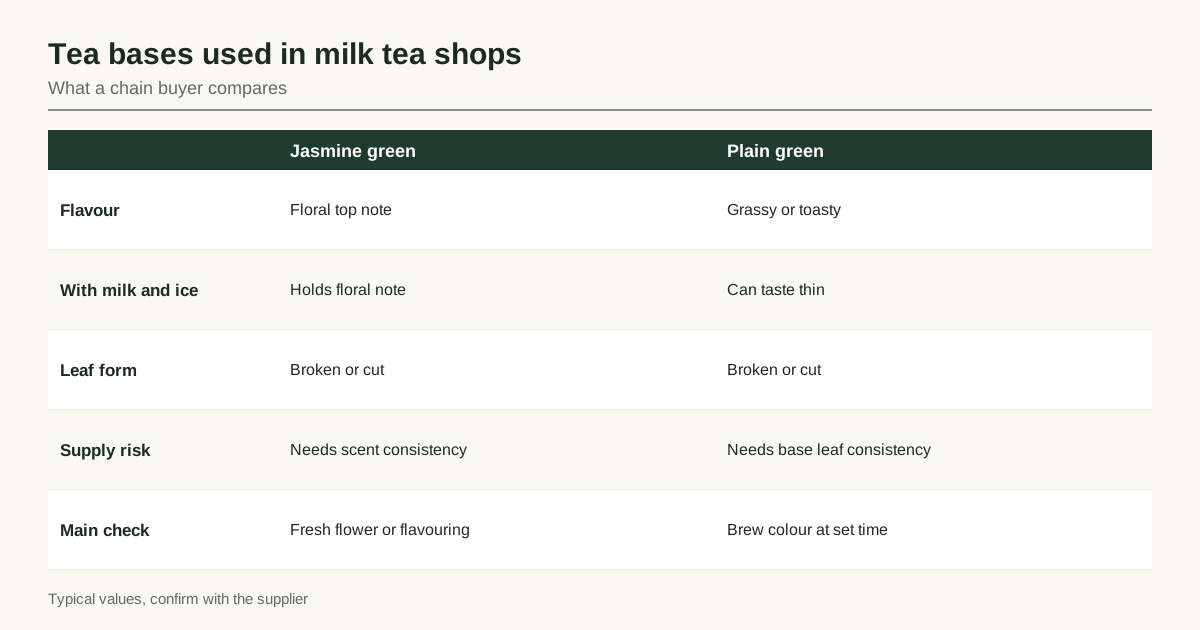
Compare the two common bases
| Point | Jasmine green | Plain green |
|---|---|---|
| Flavor | Floral top note | Grassy or toasty |
| In milk and ice | Holds floral note | Can taste thin |
| Cost | Higher with fresh scenting | Lower |
| Supply risk | Scent consistency, flower season | Base leaf consistency |
| Main check | Fresh flower or flavor | Brew color at a set time |
Volume and packing
Chains buy in volume and on a schedule. Estimate monthly tea use from the number of shops, the cups per shop and the dose per cup. Add a safety margin. Typical packs include 25 kg sacks for central kitchens and 500 g to 1 kg foil bags for shops. Smaller packs cost more per kilo but stay fresher once opened. Ask about minimum order quantities, lead times and the cost of private-label packing, and agree a delivery schedule that matches your storage. Our specification guide shows the spec lines to include.
An example of a planning method, with made-up numbers for illustration only: a chain with 50 shops selling 300 cups each per week, using 6 g of tea per cup, needs 90 kg of tea per week. At that scale, a monthly order of a few hundred kilograms in sacks is realistic. Use your own numbers.
Cold brew, batch size and holding time
Many shops brew tea hot in large batches and cool it with ice, while some use cold brew to cut bitterness and save labor. Cold brew takes hours, so it suits central kitchens or overnight prep, and it gives a smoother, sweeter base. It also needs a clean vessel and tea with a low microbial count, since the liquid stays at a moderate temperature for a long time. Hot brew is faster and easier to control but can extract more bitterness from green tea if the water is too hot.
Holding time is the other variable. Brewed tea left standing for hours loses color and freshness and can pick up off flavors. Set a maximum holding time, such as a few hours, discard tea after that and brew smaller batches more often at busy times. Put the method and the holding limit in the shop manual, so every store follows the same routine.
Residues and food safety
Chains sell to the public and often to young customers, so residue compliance matters for health and for brand. Ask for a residue report on each lot, against the limits of the market where you operate. Ask for heavy metal and microbiological results, and for a foreign matter limit. Our residue limits guide explains common panels. Ask what the supplier will do if a lot fails after delivery.
Supplier checks
Ask the supplier for samples of the exact tea, with the lot number, the production date and a certificate of analysis. Ask for a sieve analysis, a moisture result and a residue report. Ask how much they can supply per month and how fast they can scale. Ask how they handle seasonal changes in leaf and how they blend. Ask whether they can keep the same profile for a full year. A supplier with clear records and steady output is worth more than a slightly cheaper one that changes lot to lot.
See also: the market page on green tea for Taiwan, with the TFDA residue rules, border inspection and labels.
Next step
Decide the base, the cut, the brew method and the monthly volume, and write them into a spec. Then send it through the RFQ form. We introduce up to 3 matched Vietnamese suppliers within 24 business hours, and you then agree samples and trials directly with them. For the other end uses and the spec lines they share, read our guide to bulk green tea.
Frequently asked questions
Which green tea works best in milk tea?
A tea with enough body to survive milk and ice. Many chains use a stronger cut leaf or a toasted style, or a scented base such as jasmine. Test in your own recipe, since milk and sweetness change how tea tastes.
What cut should I buy for shop brewing?
Broken or cut leaf is common because it extracts quickly and evenly in large batches and strains well. Very fine dust gives cloudy tea. Ask for a size window with a limit on fines.
How do I keep taste the same across many shops?
Fix the tea lot profile, the dose, the water, the brew time and the color target, train staff on one method and compare each new lot with a sealed reference sample before it goes to stores.