- Green tea extract is made by extracting leaf with water or an ethanol and water mix, concentrating the liquid, then spray-drying it to powder.
- Catechin figures on a spec sheet mean little without the test method, and EGCG is only one part of the total.
- Residual solvents, caffeine, heavy metals and destination-market rules on EGCG all belong in an extract spec.
Green tea extract is a concentrated powder or liquid made from green tea leaf. Food and supplement makers buy it for its catechins, the group of compounds that give green tea its bitterness and much of its reputation. One catechin, epigallocatechin gallate or EGCG, is the most abundant and the one buyers most often name in a spec. Buying extract is very different from buying leaf. The product is chemistry, the spec is full of numbers and the number that sells the product depends entirely on how it was measured.
This guide explains how extract is made, what the common catechin figures mean, which solvents come into play and what belongs in a spec. It does not give health claims or dosing advice, and it is not a regulatory opinion. Rules on supplements differ by country and change often, so check your destination market.
How extract is made
The process has five main stages.
- Raw leaf. Green tea leaf, often a lower grade or a by-product such as broken leaf or fannings, is selected. The leaf must be clean and have a low residue profile, because concentration also concentrates anything unwanted.
- Extraction. Leaf is soaked or circulated in hot solvent so the catechins dissolve. The solvent may be hot water or a mix of ethanol and water. Time, temperature and the leaf-to-solvent ratio decide how much is extracted and what else comes with it.
- Filtration and concentration. Leaf is filtered out. The liquid is concentrated under vacuum to remove much of the solvent and water.
- Optional purification. To raise catechin content, the liquid may pass through resins or be washed with another solvent. This also removes caffeine, chlorophyll and other compounds.
- Drying. The concentrate is spray-dried or vacuum-dried into a powder, then sieved and packed.
Each stage changes the final composition. A water extract that is spray-dried gives a lower catechin percentage and a broader mix of tea compounds. An extract that has been purified gives a higher catechin share and a narrower composition, at higher cost.
Reading catechin figures
Spec sheets show numbers such as 40 percent, 50 percent or 90 percent. What each one means depends on three questions.
Which measure? Total polyphenols and total catechins are different. Polyphenols are a wider class measured by a general color test. Catechins are a specific group measured by chromatography. A product labeled 50 percent polyphenols may contain less than 50 percent catechins.
Which method? International method ISO 14502-2 uses high-performance liquid chromatography to determine catechins in green tea. Other methods exist, and they do not always agree. Ask the supplier to name the method on the certificate of analysis.
Which basis? Results can be expressed on an as-is basis or on a dry basis. A powder with some moisture will show a lower figure on an as-is basis than on a dry basis.
EGCG is a fraction of total catechins. In many green tea extracts it is roughly half of the catechins, though the share varies with leaf and process. If you need a minimum EGCG level for your finished product, state it as its own line on the spec rather than relying on a total.
Typical commercial levels
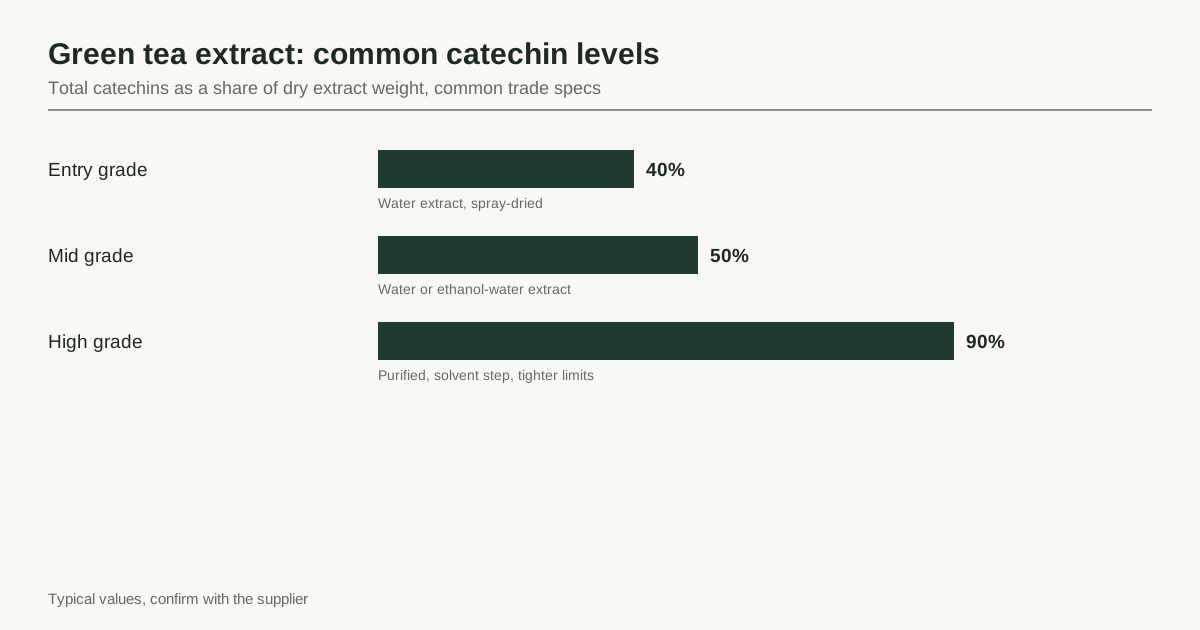
| Level | Typical method | Typical character |
|---|---|---|
| About 40 percent catechins | Water extraction, spray-dried | Lower cost, broader mix, more caffeine |
| About 50 percent catechins | Water or ethanol and water, often with a clean-up step | Common supplement grade |
| 90 percent or more | Purification step, narrower mix | Highest cost, tighter solvent and metals checks |
These are examples of grades seen in the trade, not offers. Each supplier sets its own grades and limits.
Solvents and residual solvent limits
Water is the simplest solvent and leaves nothing behind. Ethanol, usually mixed with water, extracts more of some compounds and is widely accepted in food processing. For further purification, some producers use other food-grade solvents such as ethyl acetate. Any solvent that is not water leaves a trace in the powder unless it is removed fully, and traces are limited.
Ask the supplier which solvents the process uses at every stage, not only the extraction stage. Ask for a residual solvent result on the certificate of analysis. Residual solvent limits for supplements and food ingredients are set by national rules and by pharmacopoeia guidance, and your destination market will have its own expectations. Write the solvent names and a maximum for each into the spec. If the supplier says the process is solvent-free, ask them to state in writing that no organic solvent is used at any stage.
Caffeine, color and flavor
Green tea contains caffeine, and extract carries it along. A typical extract may hold a few percent caffeine. If your finished product is meant to be low or free of caffeine, state a maximum caffeine limit and the method for measuring it. Decaffeination adds a step and adds cost, and the resulting extract may differ in color and taste.
Color and flavor matter in beverages and powders. Some extracts are pale yellow to brown and taste very bitter. Others are lighter and milder. Ask for a sample, dissolve it in your own product and judge the result.
Contaminants to specify
Concentration raises the share of anything in the leaf, including contaminants. A spec for extract usually includes:
- pesticide residues, against the limits of your destination,
- heavy metals such as lead, cadmium, arsenic and mercury,
- microbiological limits,
- residual solvents, and
- moisture and ash.
Tea plants take up metals from soil, and fluoride is also known to concentrate in tea, so ask whether the supplier tests for it. Our guide to residue limits explains how pesticide limits work for tea leaf. For extract, ask how the limits were applied to the concentrated product, since a limit set for leaf does not automatically translate into a limit for powder.
Regulatory points for supplements
Green tea extract is sold in many markets as a food ingredient and as a supplement ingredient. Rules on safe levels and labels differ. In 2022, the EU set conditions for green tea preparations that provide EGCG, including a warning on labels, after reviews of liver safety. Other markets have their own warnings or limits. Check the current rules for your destination with a regulatory adviser before writing the spec, since your finished product may need a particular EGCG level or a ceiling.
What to write in an extract spec
A short extract spec lists the product name and botanical source, the form (powder or liquid), the total catechin minimum with its method, the EGCG minimum with its method, the caffeine maximum, the moisture maximum, the particle size or solubility, the residual solvents and their limits, the contaminant limits, the microbiology limits, the packing and the shelf life. Ask for a certificate of analysis on every lot, with the lot number and the date. Our specification sheet guide shows a general layout you can adapt.
Stability, packing and storage
Extract powder is hygroscopic, which means it takes up water from the air and can clump or cake. Catechins also oxidize, so exposure to air, heat and light slowly darkens the powder and lowers the active share. Typical packing is a foil-lined bag inside a fiber drum, often with a desiccant sachet, kept cool and dry. Ask for the recommended shelf life for that packing and for a retest date on the certificate. For a long contract, ask for a stability record, even a simple one showing catechin results at the start and after several months on the shelf. A powder that shows a large drop is a warning that either the packing or the process needs work.
Batch consistency
Leaf varies from season to season, so extract varies too unless the factory blends and adjusts. Suppliers handle this by blending batches to a target, adding a carrier such as maltodextrin to standardize the final percentage, or by selecting leaf lots before extraction. Carriers are permitted in many markets but must be declared, and they matter if your label says the product is pure extract. Ask directly whether any carrier or flow agent is added, what it is and at what level. Compare certificates from three or four lots and look at the spread in catechin, caffeine and moisture. A narrow spread shows control. A wide spread means you will need a wider tolerance in your own recipe.
Capability check
Extract production needs equipment that many tea factories do not have: extraction tanks, concentration units, filtration and spray-drying. Some Vietnamese plants run these. Others buy extract from a third party and repack it. If a supplier says they make extract, ask where the plant is, what the extraction line looks like and who runs the lab. A supplier who resells extract made elsewhere can still be a fair partner, but you should know who actually makes it, because that producer sets the quality and the paperwork.
This site is an independent matching service. We introduce suppliers and do not run laboratory checks or audits ourselves, so ask the supplier for lab certificates and arrange any independent testing you want.
Next step
Write down the form, the catechin and EGCG levels with their methods, the caffeine limit, the solvent rules and the market you will sell into. Then send the spec through the RFQ form. We introduce up to 3 matched Vietnamese suppliers within 24 business hours, and you take it from there directly with them.
Frequently asked questions
What is the difference between total polyphenols and total catechins?
Polyphenols are the broad group and catechins are a subset. A spec that says 50 percent polyphenols describes a different material from one that says 50 percent catechins. Always ask which one is meant and by which method it was measured.
Can green tea extract be made without caffeine?
Yes. A decaffeination step can be added, often with a food-grade solvent or an adsorbent. Ask for the caffeine limit on the spec, because decaffeinated is not a single defined level.
Are there limits on EGCG in food supplements?
Some markets restrict or require warnings on products with high EGCG intake. The EU added a limit and label conditions in 2022. Check the current rules of your destination market with a regulatory adviser before you set a spec.
Sources
- ISO 14502-2: Determination of catechins in green tea by HPLC
- Wikipedia: Epigallocatechin gallate