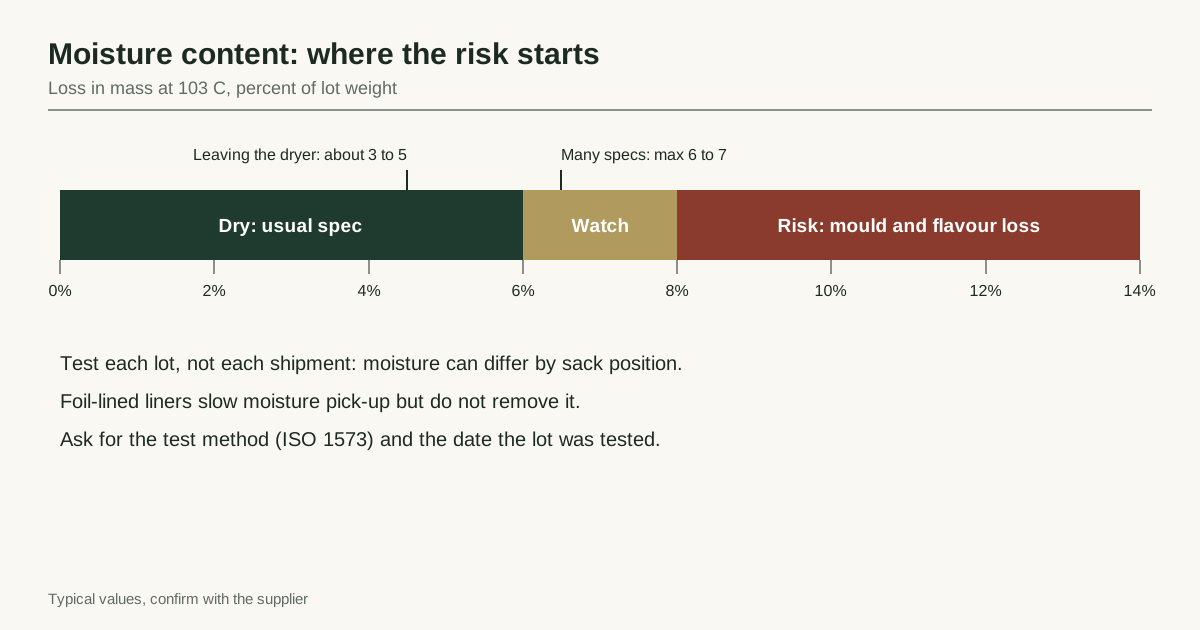
- Finished green tea leaves the dryer at roughly 3 to 5 percent moisture. Many buyer specs set a maximum of 6 to 7 percent.
- Moisture is measured as loss in mass on heating, and the result depends on the method, the temperature and the sampling, so name all three in the spec.
- A wet lot rarely fails at the factory. It fails weeks later, in a sack, in a container or in your warehouse.
Moisture is the quietest spec line in a green tea contract. It does not change how the tea looks in a sample bowl, and a good sample tastes the same at 4 percent as at 7. Yet moisture is the single number that does most to decide whether a lot is still good flavor six months after it was packed. A wet lot gives flat flavor, loses color, picks up off-smells and, in the worst case, grows mold.
This guide explains what moisture content means for tea, what numbers buyers commonly ask for, how labs measure it, what goes wrong in transit and how to write a clause that protects you. The ranges are typical figures for discussion. Confirm them with your supplier and your own technical team.
What moisture content means
Moisture content is the share of a lot’s weight that is water. In tea it is usually measured as loss in mass when a weighed sample is heated for a set time at a set temperature. A common reference method is ISO 1573, which uses 103 degrees Celsius. The result is expressed as a percentage of the original sample weight.
A related idea is water activity, which measures how freely the water in a product is available to micro-organisms and to chemical change. Two lots with the same moisture can behave differently if water is bound differently inside the leaf. For tea, moisture percentage is the figure suppliers and buyers normally quote, but water activity is a useful second check for powder and for lots that will be stored a long time.
Typical numbers
Freshly plucked leaf is mostly water. Finished green tea, after drying, holds only a few percent. Typical figures:
- Leaving the dryer: about 3 to 5 percent.
- After sorting and packing: slightly higher, because leaf takes up a little water from the air while it is handled.
- Common buyer maximum for bulk leaf: 6 to 7 percent.
- Powder: usually a lower limit, because the large surface area takes up water quickly.
Different markets and different tea types use different limits, so there is no single right number. What matters is that the limit is written, that it is tested by a named method and that the supplier tells you the tested value for your lot, not only the limit.
Why moisture decides shelf life
Water drives almost every change that makes tea go off. It lets enzymes and chemical reactions continue slowly, so the green color fades to brown and the flavor dulls. It lets molds and yeasts grow once moisture rises high enough, which makes tea unsafe as well as unpleasant. It also helps tea take up smells from its surroundings.
Because these changes are slow, a lot with moisture a little above the limit may look fine for weeks. Then it develops a musty note or a brown cast. By the time anyone notices, the lot has often been blended, bagged or sold. The gap between cause and effect is exactly why a written moisture limit is worth having.
How labs measure it
There are three common methods:
- Oven method. A weighed sample is dried in an oven at a set temperature, for example 103 degrees Celsius, then weighed again. It is slow but it is the reference method.
- Halogen or infrared moisture analyzer. A small unit heats and weighs a sample in one step and reports the result in minutes. It is convenient for factory checks and, when set up to match the oven method, gives similar figures.
- Handheld meters. These estimate moisture from electrical properties. They are quick but depend on calibration for the specific tea, so use them for screening only.
When a spec gives a moisture limit, name the method and the temperature next to it. A result from a halogen unit at 105 degrees can differ from an oven result at 103 degrees because tea loses small amounts of volatile aroma compounds as well as water. The difference is usually small, but it can decide whether a lot sits just inside or just outside a tight limit.
Sampling matters as much as the method
A lab result describes the sample, not the lot. A good sampling plan takes small amounts from several sacks across the lot, mixes them and tests the mix. A poor plan takes a handful from the top of one sack. Moisture can differ between sacks, particularly between those packed at the start of a run and those packed at the end. It can also differ between the outside and the middle of a sack.
ISO 1839 describes a standard approach to tea sampling. You do not have to follow it to the letter, but you should ask the supplier how the sample was drawn and write the number of sacks sampled into your spec. If you test on arrival, use the same approach so the two results can be compared.
Where lots get wet
A lot can be dry at packing and wet on arrival. The usual causes are:
- Packing before the tea has cooled. Warm tea sealed in a bag releases moisture inside the bag.
- Paper sacks without a liner. Paper breathes. A foil-lined or plastic-lined inner bag slows moisture uptake.
- Humid storage. A warehouse in a wet season can add water to open or poorly sealed sacks.
- Container condensation. Temperature swings during sea freight can make water form on the inside of the container roof and drip on cargo. Desiccant bags and liners reduce the risk.
- Mixed cargo. Wet cargo in the same container can raise humidity for everything else.
For transit planning, see also the importer guide, which sets out typical packing and freight steps.
Moisture limits at a glance
| Product | Typical maximum moisture | Notes |
|---|---|---|
| Bulk green leaf | 6 to 7 percent | Test by a named method |
| Scented green tea | Same as plain, after final drying | Scenting adds water, so re-drying must be complete |
| Green tea powder | Lower, often 5 percent or less | Fine powder takes up water quickly |
| Tea bags (cut leaf) | 6 to 7 percent | Packed in sealed film or foil |
A practical clause
A moisture clause in a contract has four parts: the maximum, the method, the sampling plan and the remedy. For example, state that moisture must not exceed the agreed percentage when tested by loss in mass at 103 degrees Celsius on a composite sample drawn from a stated number of sacks. Add that the supplier supplies a result for the lot before shipment. Add that a retained sample from the same lot is sealed and kept by both sides. Add what happens if the arrival result is above the limit: replacement, price adjustment or rejection. A clear remedy removes most of the argument later. Our specification sheet guide shows where a moisture line sits in a full spec.
What to do when a lot arrives wet
First, stop. Do not blend or bag the lot. Take samples from several sacks, photograph the condition of the sacks and the container, and keep the container paperwork. Test moisture by the method in your contract and test a retained sample for comparison. If the result is above the limit, notify the supplier in writing at once with the numbers and the photos. Many suppliers will agree to a remedy when the evidence is clear. If the tea is only slightly above the limit and has no off-smell, some buyers re-dry it at their own plant, but this needs care because heating can dull the color.
Reading a supplier’s moisture record
Ask for the moisture result by lot, not as a general statement. A useful record shows the lot number, the date, the method, the result and who ran the test. Ask how often the factory checks moisture during drying, since a plant that tests each dryer batch catches a problem early, while one that tests only the finished lot finds it late. A factory that offers a run of results across several lots gives you a sense of its spread. A tight spread, for example all results within a point of each other, suggests a controlled dryer. A wide spread suggests that some lots are drier than others and the average hides the risk.
Storage tips for the buyer
Store sacks off the floor on pallets, away from walls and away from strong smells. Keep the store cool and dry. Open sacks only when needed and reseal them with a tight tie or a bag clip. Use the oldest lot first. Tea absorbs smells, so keep it away from spices, cleaning products and fuel.
Next step
Decide your moisture maximum, your test method and your sampling plan, then put them in a written spec. You can send the spec through the RFQ form. We introduce up to 3 matched Vietnamese suppliers within 24 business hours. This site is an independent matching service. You and the supplier agree the testing and any third-party inspection directly. Moisture is one line of the full green tea spec: see our guide to bulk green tea.
Frequently asked questions
What moisture limit should I put in a green tea spec?
Many buyers use a maximum of 6 to 7 percent for bulk leaf and a lower figure for powder. Confirm the number against your own shelf-life needs and ask the supplier what they actually achieve, since most lots finish below the limit.
Can I test moisture myself?
A lab oven or a halogen moisture analyzer gives a usable result if you follow the same method each time. Handheld meters are fast but vary by tea type and must be calibrated against an oven result.
How long does green tea keep?
Properly dried green tea in sealed foil-lined packing commonly carries a best-before date of about 18 to 24 months. Flavor and color fade before it becomes unsafe, and the real life depends on moisture, oxygen, light and temperature.
Sources
- ISO 1573: Tea, determination of loss in mass at 103 C
- Wikipedia: Water activity