- RTD bottlers need green tea that extracts predictably, gives stable color through heat treatment and carries low and well documented residues.
- Steamed leaf is the usual starting point for a green liquor, but fine fines, particle size and dosing rate matter as much as style.
- Always trial the tea on your own line. A tea that looks good in a cupping bowl can brown after heat treatment.
Bottled green tea looks simple on the shelf. A clear green drink, a short ingredient list, a refreshing taste. Behind it sits a tight set of specs for the tea itself, because an RTD line magnifies every small difference in the raw material. A tea that tastes good in a cup can turn cloudy, brown or bitter after it has been extracted at scale, filtered, filled and heat treated. Bottlers who know this write their tea spec with care, and suppliers who know it send better samples.
This guide lists the specs RTD bottlers commonly ask for, explains why each matters and shows how to put them into an RFQ to Vietnamese suppliers. It does not give formulas, since every plant differs. The values are typical starting points that you should confirm in your own pilot.
What an RTD line does to tea
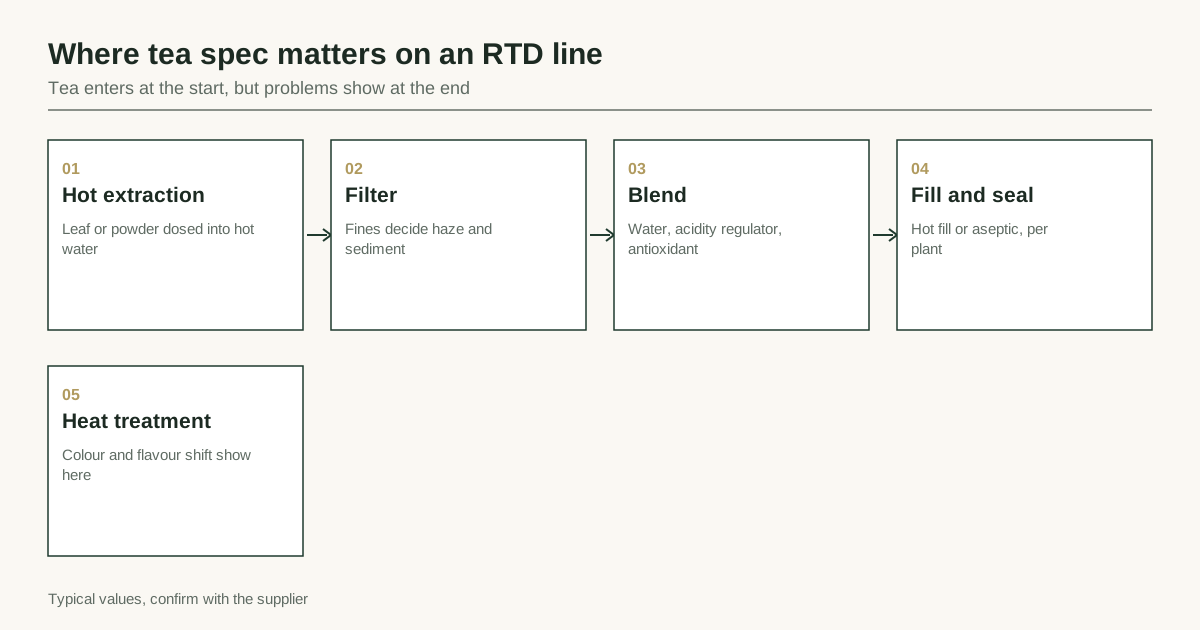
A typical line extracts tea in hot water, filters the liquid, blends it with water and other ingredients, fills bottles or cans, seals them and applies a heat treatment such as hot fill, tunnel pasteurization, retort or aseptic filling. At each step the tea can change.
Extraction pulls out color, flavor and bitterness. Filtration removes leaf particles, but fine material can pass through and cause haze or sediment later. Blending sets pH and adds ingredients such as sugar or antioxidant. Heat treatment drives chemical changes that can brown the liquor and dull the flavor. A good tea spec is built backwards from these steps.
Leaf style
Steamed green tea is the usual starting point, since steaming fixes the leaf with moist heat and keeps a greener color and fresher, grassier flavor. Pan-fired tea gives a toasty, sweeter taste and a more golden liquor. Both can work in RTD, but they suit different drinks. A bright green, vegetal drink often starts from steamed leaf. A toasty, roasted style drink may start from pan-fired leaf. Our guide to steamed versus pan-fired green tea covers the differences in detail.
State the style on the spec. A line that says only green tea invites the supplier to send whichever is easiest to fill.
Particle size and fines
For leaf extraction, particle size sets extraction speed and filtration. Smaller particles extract faster, so a short extraction is enough, but they also pass through filters more easily and can leave haze. Larger pieces extract slowly and are easier to filter. Many plants use broken leaf or fannings with a controlled size window and a limit on dust.
Write a size window, a limit on fines and a stalk limit into the spec. Fines are a frequent cause of cloudy bottles. Stalk adds bitterness and pale color. If your plant filters through fine mesh or uses centrifuges, ask the supplier for a sieve analysis of the offered lot.
Extraction behavior
Bottlers care about how a tea behaves in their extraction conditions: yield of soluble solids, color, bitterness and aroma. Extraction temperature, time and water quality all matter. The supplier cannot know your plant, so offer a sample and run your own extraction trial. Compare two or three candidate lots at the same dose, the same temperature and the same time, and measure soluble solids, color and taste.
Typical dosing for a lightly flavored RTD green tea is in the low single-digit grams of leaf per liter of finished drink, though recipes vary widely. Treat any figure as a starting point for your pilot, not a rule.
Color stability
Color is the main visible quality of green tea drinks, and it is fragile. Green tea liquor tends to shift from green toward yellow and brown with heat, with oxygen and with time. Bottlers manage this in several ways: choosing a leaf with good color retention, controlling extraction temperature and time, adjusting pH, adding an antioxidant such as ascorbic acid where permitted, reducing oxygen in the headspace and storing cool and dark.
The tea spec supports this. Ask the supplier for tea with low moisture, no signs of over-firing or old stock, and consistent color from lot to lot. Ask for the production date. Fresh tea usually holds color better than old tea.
Flavor and bitterness
Bitterness and astringency come from catechins and caffeine, and they rise with hotter and longer extraction. Many RTD drinks aim for a clean, mild taste, and the tea spec reflects that by favoring leaf from younger plucking and by limiting stalk and coarse leaf. Others, such as unsweetened Japanese-style drinks, accept more astringency. Define the cup you want by sensory approval against a type sample and record the brew conditions used to approve it.
Residues and contaminants
RTD makers sell to consumers, and many sell to strict markets. The tea going in must meet the residue limits of the destination for dried tea, and the finished product must meet its own limits. Ask for a residue report on each lot, with a panel that matches your market. Also ask for heavy metal and microbiological results, and for foreign matter limits. Our residue limits guide explains the common panels.
For extract and concentrate, the limit calculation can differ from that for leaf, because processing concentrates or removes compounds. Ask your regulatory adviser how to treat these products.
Water, pH and the rest of the recipe
Green tea does not act alone in a bottle. The water you use changes extraction. Hard water with high mineral content can dull color and lift bitterness, while soft or treated water gives a cleaner result. pH matters too, since green tea catechins are more stable in mildly acidic conditions than in neutral or alkaline ones. Many bottlers adjust pH with a food acid and may add a small amount of bicarbonate to balance it, depending on the recipe and local rules. Sugar, sweeteners, flavors and milk all change how the tea tastes and looks. So a tea that works in a plain, unsweetened drink may need a different grade for a sweetened one. Tell your supplier the recipe type, not only the tea, so that the samples they send are close to your use.
Cold brew and low-heat routes
Some makers avoid hot extraction and use cold or warm extraction to protect flavor and color. Cold extraction takes hours instead of minutes and pulls out less bitterness and fewer tannins, giving a sweeter and clearer cup, though it extracts less in total and needs strict hygiene because the liquid sits at moderate temperature for a long time. If you plan a cold route, tell the supplier. Lower-bitterness leaf, a coarser cut that filters cleanly and a very low microbial load matter even more, and the heat treatment step after filling takes on more of the safety burden. Run the pilot on your own cold route and check taste and microbes together.
Supply continuity
Bottlers buy tea for a full year of production, and they dislike surprises. Agree the lot size, the delivery schedule and the quality tolerance in advance. Ask the supplier how they handle seasonal swings, whether they hold stock of the same blend and how they will tell you if a lot has to change. A written approval process for any change in leaf source, process or packing saves arguments later. Keep a sealed reference sample for every approved lot, and compare each new lot against it before it goes into the tanks.
Moisture, packing and traceability
Dry tea keeps better and extracts more predictably. Typical limits for leaf are a maximum moisture of 6 to 7 percent, tested by a stated method. Pack in foil-lined sacks with a lot number on each. Ask for a certificate of analysis for each lot, tied to the lot number, so you can trace any issue back from the bottle to the tea.
Comparing tea forms for RTD
| Form | Strength | Watch for |
|---|---|---|
| Leaf (broken or fannings) | Flexible, low cost per kilo of tea | Needs extraction tanks, fines control |
| Powder | Fast dispersion, simple dosing | Clumping, sediment, color |
| Extract or concentrate | Consistent, easy to dose | Higher price, carrier and solvent questions |
A practical spec checklist
- Style: steamed or pan-fired.
- Grade and size window, with fines and stalk limits.
- Moisture maximum and test method.
- Color and taste approval against a type sample.
- Residue panel for the destination market.
- Heavy metals and microbiology limits.
- Packing, net weight and lot number.
- Certificate of analysis per lot.
- Production date and shelf life.
- Sample quantity for a line trial, usually several kilos.
Our specification sheet guide shows how to lay these out.
Running a trial
Ask for a trial lot large enough to run on a pilot line, not only a 200 g sample. A few kilograms gives enough tea for several extractions. Run the trial the same way you plan to run production. Record the dose, temperature, time, soluble solids, pH, color and taste at the start and after heat treatment. Store bottles under your normal conditions for the shelf life you plan and re-test color and taste at intervals. A trial that includes a storage test finds problems that a same-day taste would miss.
Next step
Decide the style, the form and the key limits, then send your spec through the RFQ form. We introduce up to 3 matched Vietnamese suppliers within 24 business hours. You then agree trial lots and testing directly with them. To compare RTD needs with bags, chains and kombucha, see our guide to bulk green tea.
Frequently asked questions
Should an RTD maker buy leaf, powder or extract?
All three are used. Leaf suits plants with extraction tanks. Powder dissolves or disperses quickly and suits simple lines. Extract and concentrate suit makers that want a consistent base. The choice depends on your equipment and your label.
How do I stop green tea drinks from turning brown?
Color loss comes from heat, oxygen, light and pH. Bottlers manage it with the right tea, careful extraction, antioxidants such as ascorbic acid where permitted, pH control, low oxygen filling and cool dark storage. Run a pilot to find what works with your tea.
What residue standard should I ask for?
Use the standard for the market where the drink will be sold. Residue limits for tea apply to dried leaf, and the concentration step changes the picture for extract, so ask your regulatory adviser how to apply them.