- Food makers judge green tea powder on color, flavor, particle size, microbiology and how it behaves in heat, not on the word matcha.
- Typical trial doses run from about half a percent to a few percent of finished weight, and color fades or browns depending on the product.
- Run your own bake or process trial on at least two powders from different suppliers before committing to volume.
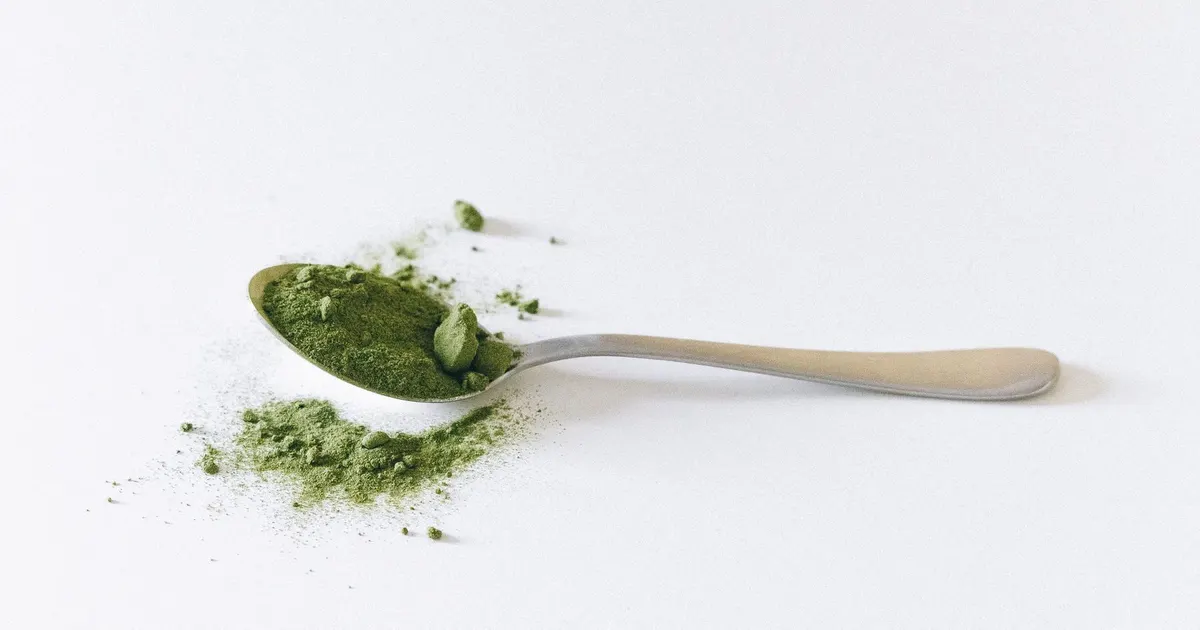
Green tea powder is now a regular ingredient in cakes, biscuits, ice cream, noodles, chocolate, beverages and sauces. Buyers in these industries do not care about tea ceremony. They care about three plain questions. Does the powder give the color we need, does it taste right and does it behave in our process? This guide sets out what food and bakery manufacturers usually specify when they buy green tea powder in bulk, and how to check a Vietnamese supplier’s powder against those needs.
The figures here are typical starting ranges to guide a trial. Every recipe and every plant is different, so confirm the numbers in your own tests.
Powder is not the same as matcha
Matcha in the strict Japanese sense is made from shade-grown tencha leaf, steamed, dried and stone-milled. Much of the green tea powder sold for food is something else: green tea made from unshaded leaf, milled into a fine powder. It can be an excellent ingredient, with a good green color and a pleasant tea flavor, but it has a different amino acid balance and often a different color from true matcha. Suppliers from Vietnam mostly sell the second type. If a supplier calls a powder matcha, ask which leaf and which process. Our private label guide covers how to describe powder on a label.
What manufacturers specify
Color. Bright green is the target. Specify the color by sight against a type sample and, if you can, by instrument values on a named device with a stated light source. A paler or yellower powder gives a duller product.
Flavor. Fresh, green and slightly sweet is typical. Bitter, burnt or hay-like notes are faults. Judge by tasting the powder in a simple base, such as milk or a plain sponge, not only in water.
Particle size. Finer powder disperses better and gives a smoother texture, while coarser powder can feel gritty in a cream or chocolate. State the target as a size distribution measured by a named method.
Moisture. Powder takes up water fast. State a maximum, often lower than for leaf, with the method.
Microbiology. Powder is a raw agricultural ingredient. Typical limits cover total plate count, yeasts and molds, coliforms and Salmonella. Set limits to suit your own process.
Contaminants. Ask for pesticide residues against your destination limits, heavy metals and foreign matter. Because powder is a processed form of tea, ask your regulatory adviser how limits apply. See our residue guide.
Flowability. Powder can clump. If you use automated dosing, ask for a flow test or a trial on your equipment.
Typical starting doses
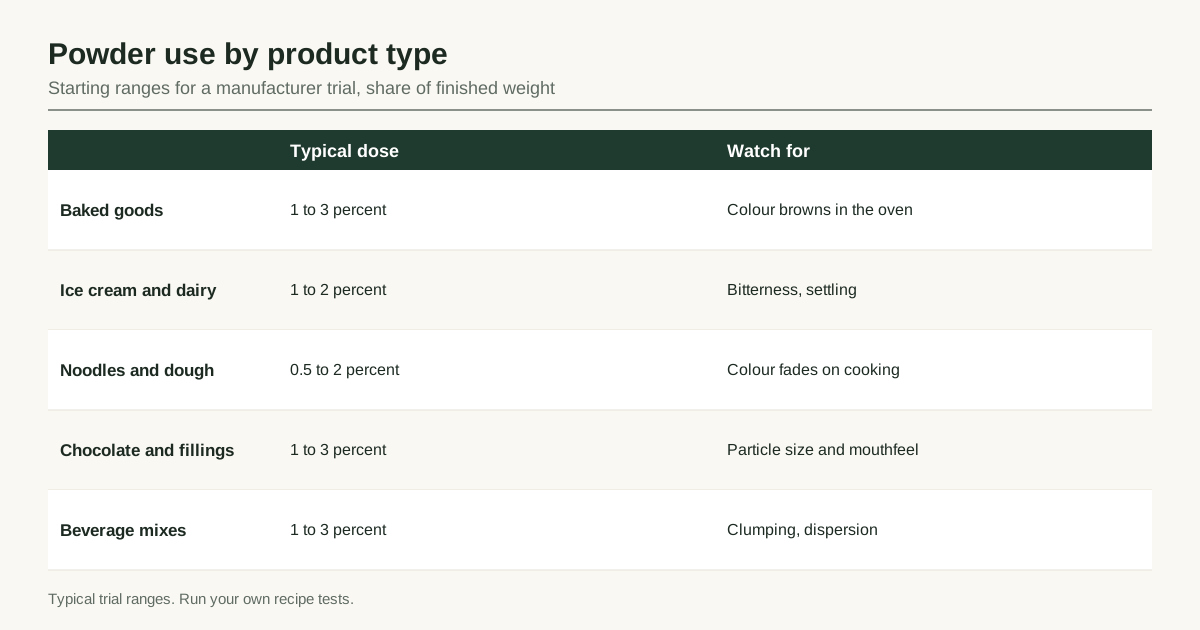
Dose depends on the product and the intensity you want. The table shows trial ranges as a share of finished weight. They are starting points, not rules.
| Product | Typical trial dose | Common issue |
|---|---|---|
| Cakes and biscuits | 1 to 3 percent | Color browns in the oven |
| Ice cream and dairy desserts | 1 to 2 percent | Bitterness, settling |
| Noodles and dough | 0.5 to 2 percent | Color fades on cooking |
| Chocolate and fillings | 1 to 3 percent | Particle size, mouthfeel |
| Beverage mixes | 1 to 3 percent | Clumping, dispersion |
Run trials at three dose levels and compare color and flavor. A small increase in dose can intensify bitterness faster than color.
Heat and color
Heat is the main enemy of color. The green in tea powder comes from chlorophyll, which breaks down with heat, acid and long exposure to oxygen. In baking, a long or hot bake turns a bright green to olive and then brown. Alkaline conditions, such as a batter with a lot of baking soda, can shift the color. Practical steps include shorter bake times, lower temperatures where the product allows, covering surfaces, keeping pH in a suitable range and choosing a powder with good color stability. Packaging that blocks light also helps the finished product keep its color.
Ask the supplier whether they have bake or heat test data. Even a simple comparison of two powders in the same recipe can show a clear difference.
Flavor pairing and masking
Tea flavor is delicate and some ingredients mask it. Strong chocolate, heavy spices and a lot of sugar can bury the tea note, while white chocolate, vanilla, milk and cream carry it well. Adjust sweetness and fat to let the tea show. Trial different recipes with the same powder before concluding that a powder is flat.
Labeling and claims
In the EU and many other markets, an ingredient list should name the tea powder correctly, for example green tea powder, and not use terms with a legal meaning that the product does not meet. Claims such as organic need certificates. Claims about health effects are regulated and need to follow the rules of your market. Allergen handling is another point: ask whether the line is shared with other products and how it is cleaned.
Dispersion in liquids, doughs and fats
Powder behaves differently depending on what it meets. In water or milk it forms lumps unless it is sifted and whisked or mixed with high shear, and it settles over time because tea particles are denser than the liquid. In dough, it mixes best when blended dry with flour before liquid goes in. In fats such as butter or chocolate, it disperses well when the particles are fine, but a coarse powder feels gritty. In ice cream, powder is usually added to the mix before pasteurization or blended with sugar first to avoid clumping. Tell your supplier how you plan to use the powder, because particle size, surface treatment and bulk density can all be adjusted at the mill and the right choice depends on the process.
Shelf life of the finished product
A food made with green tea powder will lose color on the shelf, and the rate depends on light, oxygen, water activity and temperature. Opaque or light-blocking packaging helps. So does a low oxygen headspace and a cool store. Plan a shelf-life test for the finished product, with color and flavor checks at the start, the middle and the end of the planned life. Record the powder lot used, so that if color fades faster in one batch you can compare the powder records. Two lots of the same grade can differ in color stability, which is why a type sample and a lot-by-lot color check are worth the effort.
Seasonal and lot variation
Green tea powder comes from leaf, and leaf varies. Spring leaf gives a brighter green and a sweeter taste than summer leaf, and a powder made from summer leaf may be darker and more bitter. Suppliers often blend lots to keep color steady, but a change in season can still show up in your product. Ask the supplier how they handle it, and ask whether they hold stock of the approved blend. For a continuous line, agree a color tolerance, a flavor approval method and a sample schedule, such as a sealed sample with each shipment.
Packing and storage
Typical packing is a foil-lined bag in a carton or a lined drum, often 5 to 20 kg for industrial buyers, sometimes flushed with nitrogen. Cool, dry, dark storage keeps color and flavor. Powder absorbs smells, so keep it away from strong odors. Ask for the production date and the shelf life for the packing used, and use oldest stock first.
Choosing between suppliers
Request samples from at least two suppliers, and ask each to send the same details: leaf, process, color, particle size, moisture, microbiology, residue results and packing. Run side-by-side tests in your own recipe, with the same dose and the same bake. Taste each in a plain base. Write down the results, and keep sealed samples as your type standard. Prices vary with leaf quality and with the milling method, so make sure quotes are for the same spec.
Questions to ask about capacity
Ask how many tons per month the supplier can mill in the specification you want. Ask whether they mill themselves or buy powder from another plant. Ask how they control color from lot to lot, and how they handle seasonal changes in leaf. Ask what quality records they keep, and how fast they can respond to a complaint. A supplier with a clear process and clear records usually runs a stable line.
Next step
Write down your use, the color and particle size targets, the moisture and microbiology limits, the residue standard and the packing. Then send the spec through the RFQ form. We introduce up to 3 matched Vietnamese suppliers within 24 business hours, and you then agree samples and trials directly. Our specification guide shows how to lay out the spec.
Frequently asked questions
Is cooking-grade green tea powder different from drinking grade?
Usually yes in leaf quality and price, but there is no single defined grade. Ask the supplier for color values, particle size, taste notes and the leaf used, then test in your own recipe.
Why does green tea powder turn brown when baked?
Heat, long baking times, alkaline batters and exposure to oxygen all dull the green of chlorophyll. Recipe changes, shorter bake times and a more stable powder can reduce it, but some color shift is normal.
What microbiology limits should I ask for?
Set limits to suit your product and process. Powder is a raw agricultural ingredient, so ask for total plate count, yeasts and molds, coliforms and absence of Salmonella, and check whether your own process includes a kill step.