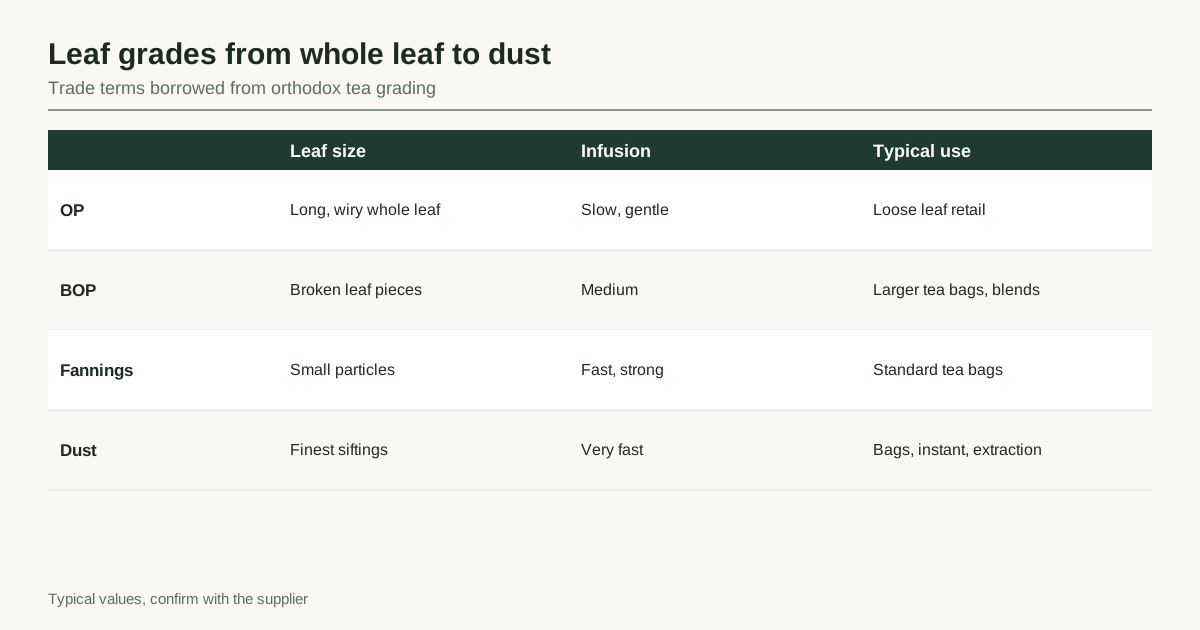
- OP, BOP, fannings and dust are size grades borrowed from orthodox tea trading. Smaller particles brew faster and stronger and usually cost less.
- The same grade letters can mean different cut sizes at different factories, so a spec should add a mesh range or size window.
- Choose by end use: whole leaf for loose retail, broken for blends and larger bags, fannings and dust for standard bags and extraction.
Order tea from Vietnam and one of the first lines in your spec will be a grade: OP, BOP, fannings or dust. These terms look technical, and they are, but they only describe one thing. They tell you how big the pieces of leaf are after sorting. They say nothing directly about flavor, freshness, residue status or the quality of the plucking. Buyers who treat the grade as a quality score tend to be surprised. Buyers who treat it as a size code do not.
This guide explains each grade, shows how leaf size changes brewing and price, covers the way Vietnamese suppliers use the terms and gives a way to write the grade so two suppliers produce the same thing. Our green tea grades page lists the grades this site refers to, and this article goes into more detail on the size side.
Where the grade names come from
Grade letters began in black tea trading in India and Sri Lanka. After sorting, tea is sieved into size groups and each group is given a label. The same labels spread across the tea trade, including green tea. They are short and easy to quote in a price list, but they are loose. Each producing region and each factory sets its own meaning of the letters within a broad range.
This matters for green tea more than people expect. A green tea factory often makes the leaf in a style such as twisted pan-fired or steamed needle, and then sorts it. The sorting produces size fractions, and the factory uses the nearest black tea label for each. So a “BOP” from one factory and a “BOP” from another may differ in cut and in shape.
What each grade means
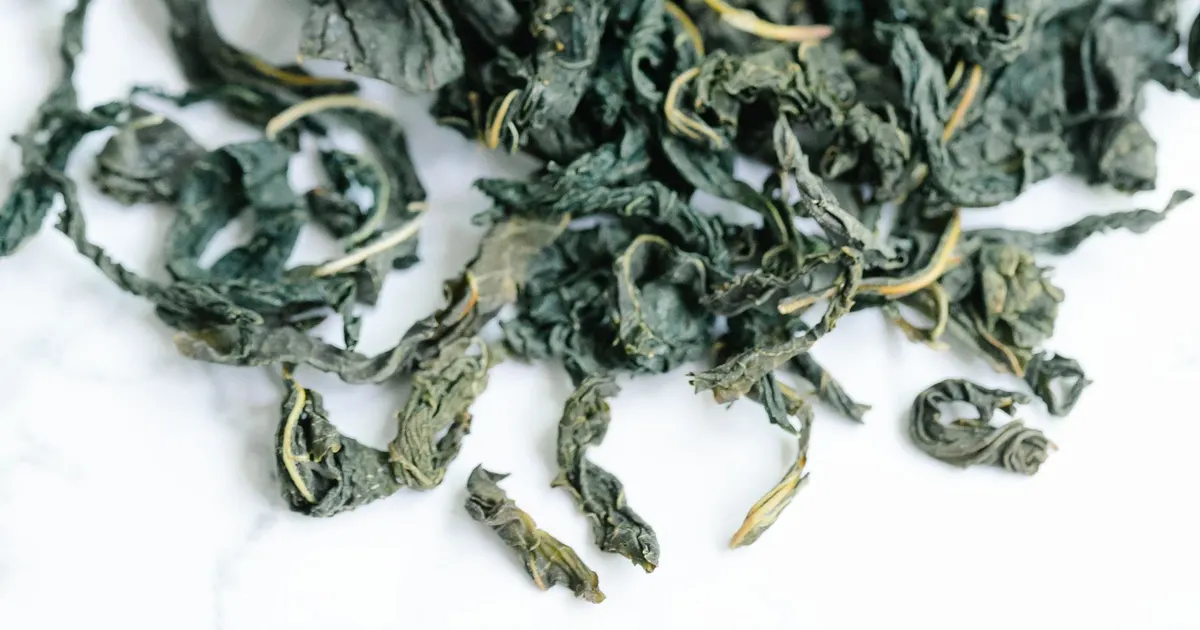
OP (orthodox pekoe). Long, wiry or twisted whole leaf. It is the largest regular grade and the most visual. OP leaf takes longer to brew, gives a gentler cup and looks good in clear retail packs. It is used for loose-leaf retail and for premium blends.
BOP (broken orthodox pekoe). Pieces of leaf that have been broken or cut to a smaller size. They brew faster and give a stronger cup than OP. BOP is common for larger tea bags, for blends and for food service.
Fannings. Small particles, finer than BOP. They brew fast and strong and pack densely. Fannings are the standard fill for conventional flat tea bags.
Dust. The finest fraction from the sieve. It brews almost at once and is used in bags that need a quick strong cup, in instant tea bases and in extraction.
How size changes the cup and the cost
Smaller particles have more surface area for the water to reach, so they release flavor and color faster. A tea that takes four minutes to brew as OP may give a full cup in two minutes as fannings. Smaller particles also make a stronger, sometimes more astringent liquor in the same time. This is useful for bag tea and for iced tea bases, and less useful for sipping tea where subtlety matters.
Cost follows the opposite direction for flavor but the same direction for appearance. Whole leaf takes more care to pluck, roll and sort, and it looks better, so it carries a higher price. Fannings and dust are partly by-products of sorting and are priced below leaf. This is not always true at the very top of the market, where selected bud grades are priced separately, but it is a fair guide for standard green tea. Our price guide puts relative tiers side by side.
Typical size windows
Sizes are not standardized across the trade, so the figures below are broad ranges for orientation only.
| Grade | Typical size | Typical use |
|---|---|---|
| OP | Long leaf, several millimeters to a few centimeters | Loose-leaf retail |
| BOP | Broken pieces, roughly one to a few millimeters | Larger bags, blends |
| Fannings | Fine particles, around one millimeter or less | Standard flat bags |
| Dust | Very fine, well under a millimeter | Quick-brew bags, extraction |
When you need a specific cut, the right way to say it is a mesh range, not a grade letter. A mesh number tells you how many openings a sieve has per inch. For example, a spec might say that 90 percent of the lot passes one mesh and stays on another. The exact figures belong to your packer or your product team, who know what runs on their machine.
What a good spec adds to the grade
A grade letter alone leaves a lot open. Add:
- A size window. A mesh range, or a sieve analysis showing the share of the lot in each size band.
- A fines limit. For grades above dust, state the maximum share of dust allowed. Too much dust makes a cloudy liquor and clogs filter paper.
- A stalk limit. Stalk is pale and bitter, and it shows in a clear bag.
- A leaf style. Twisted, needle, flat or pellet, because style affects density and brewing.
- A moisture maximum. See our specification sheet guide for how this fits in a full spec.
With these lines, two suppliers can quote the same product, and you can compare prices honestly.
Density and fill weight
Different grades pack differently. Whole leaf is bulky, with a low weight per liter. Fannings are compact. If you pack tea bags, a grade with a higher density fills a bag more evenly and runs faster on the machine, while a bulky leaf can bridge in the hopper. If you ship tea, a grade with a lower density needs more volume in the container, which raises freight per kilo. Ask the supplier for the bulk density of each grade, measured by a stated method, and use it to plan fill weights and sack counts.
Matching grade to end use
| End use | Common grade | Why |
|---|---|---|
| Loose-leaf retail | OP | Looks good, brews gently |
| Premium blend | OP with BOP | Balance of look and strength |
| Large tea bags | BOP | Fills bag, brews quickly |
| Standard flat bags | Fannings | Dense, fast, even fill |
| Quick-brew bags and extraction | Dust | Very fast release |
| Iced tea and RTD base | BOP or fannings | Fast extraction, strong color |
These are starting points. Test your own use before you commit to a contract.
How to run a simple sieve analysis
A sieve analysis tells you what is really in a lot. Take a 100 g sample, weigh it and pour it onto a stack of sieves with the coarsest at the top. Shake the stack for a set time, usually a few minutes, then weigh what stays on each sieve and what falls through to the pan. Express each result as a share of the total. The result is a size profile of the lot, for example the share above the first sieve, the share between the two middle sieves and the share in the pan.
Run the test on the type sample and write the profile into the spec as a target with a tolerance. On arrival, run it again on a composite sample from several sacks and compare. A lot that shows more dust than the type sample may have been rough-handled, over-sieved or blended with a finer fraction. A lot with more oversize leaf may have been cut less than agreed. Either difference changes the way the tea brews and fills bags, so a written tolerance spares both sides a long argument.
Questions to ask a supplier about grades
Ask which letters they use for each size and what the size window is for each. Ask whether grades are made by sieving only or whether leaf is also cut by machine to reach a size. Ask how the factory handles the dust that results from sorting, since a good plant removes dust from higher grades and sells it separately. Ask for a sieve analysis of the offered lot, not just the grade name. Ask how many grades the line can run and how fast it can switch from one to another, because a change of sieve between lots is a common reason for a shift in cut size.
Grade is not quality
A common mistake is to assume OP is better than BOP in every way. It is not. Quality depends on plucking, processing, drying and storage. A fresh, well made BOP can beat an old, poorly made OP in the cup. The reverse is also true. If quality is your first concern, write quality lines into the spec, such as plucking standard, moisture, residue status and sensory approval against a sample, and treat the grade as one line among them.
Common problems with grade claims
Buyers meet a few patterns again and again. A supplier labels a lot with a higher grade than its leaf supports, for example BOP that contains a high share of dust. A supplier ships a lot that matches the sample on the day but varies between sacks. A supplier changes the cut size between shipments because a sieve was changed. To manage these risks, agree a sieve analysis on the type sample, run the same test on arrival and keep a retained sample of each lot. The same sample chain used for any green tea lot applies here.
See also: the reference pages on OP green tea and on the pekoe grades P, BP, BPS and PS.
Next step
Write down your end use, the grade and the size window, and add stalk, fines and moisture limits. Then send the spec through the RFQ form. We introduce up to 3 matched Vietnamese suppliers within 24 business hours, and you agree samples and sieve tests with them directly. For the full route from end use to a written sieve window, read our guide to bulk green tea.
Frequently asked questions
Do OP and BOP mean the same thing for green tea as for black tea?
The letters come from black tea grading, and green tea traders borrow them as shorthand for leaf size. They describe size and shape, not quality or flavor, so a well made BOP can be better than a poor OP.
Which grade is best for tea bags?
Fannings are the standard choice for ordinary flat bags because they brew fast and fill a small bag evenly. Larger pyramid bags can use broken leaf or larger cuts. Ask your packer for the cut that runs best on the machine.
Why is dust cheaper?
Dust is the finest sieve fraction. It is a by-product of sorting, brews very fast, and has less visual appeal, so it is priced below leaf grades.