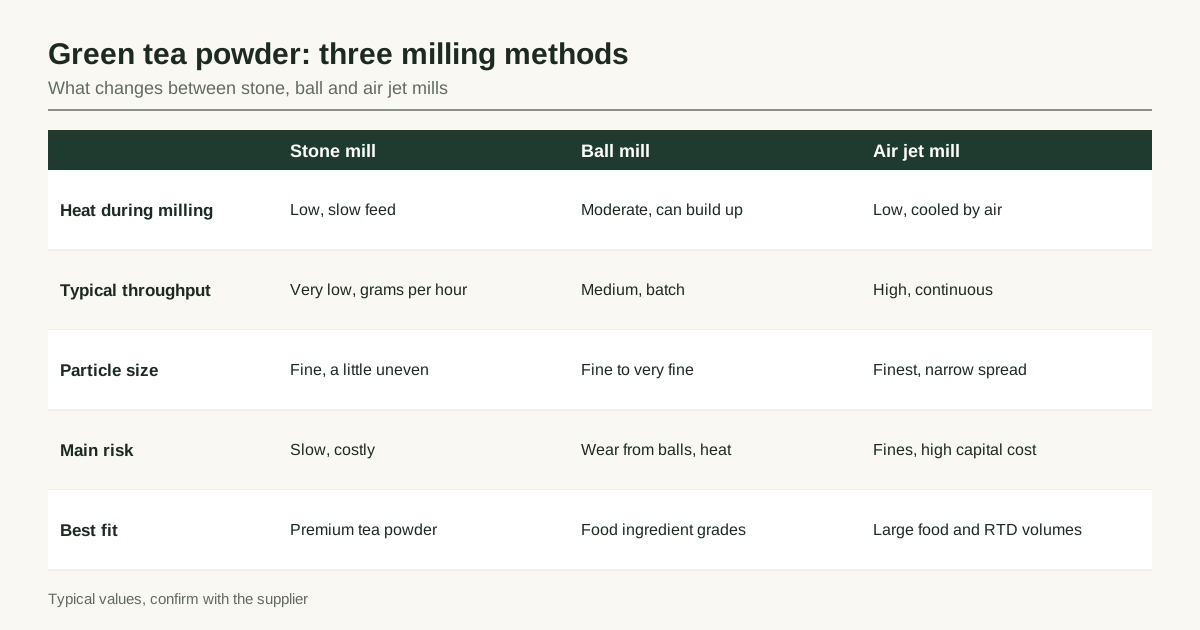
- Stone mills grind slowly with little heat, ball mills suit mid-volume food grades and air jet mills reach the finest, most uniform powder at large volume.
- Milling method affects color, flavor and texture, but the quality of the input leaf matters more.
- Most powder sold from Vietnam is milled green tea, not shade-grown tencha matcha. Ask for the full process rather than trusting the word matcha.
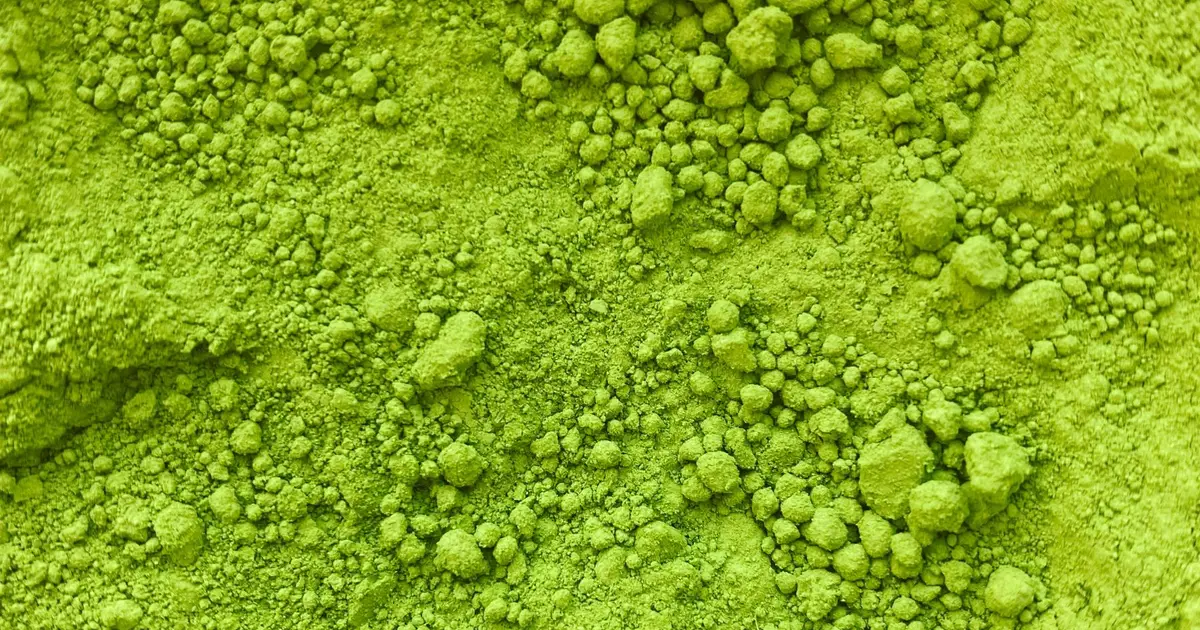
Turning dry green tea leaf into powder looks like a simple grinding job, but the choice of mill changes the color, the texture in the mouth and the price per kilo. Buyers of powder for beverages, ice cream, bakery or supplements often ask which method is better. The honest answer is that each method suits a different product and a different volume.
This guide compares the three common ways to mill green tea, explains what each does to the leaf and lists the spec lines that matter when you order powder from Vietnam. The figures are typical ranges for discussion. Each mill and each factory runs differently, so confirm the numbers on the sample lot.
Start with the leaf, not the mill
A mill can only reduce particle size. It cannot add color, sweetness or freshness that the leaf lacks. Powder quality starts with the base tea: the plucking standard, the way the leaf was fixed and dried, and how clean it is. Stalk and fiber are hard to grind and show up as gritty texture. Yellow or brown leaf shows up as a dull powder.
Moisture matters at the mill door as well. Leaf that is too moist gums up the grinding surface or clumps in the hopper. Leaf that is bone dry grinds cleanly but may pick up water from the air afterwards. Most powder lines work from tea that is dried to a low moisture and pre-cut to a small size before the main mill.
Stone milling
A stone mill uses a pair of granite wheels that turn slowly against each other. Leaf is fed in a trickle and ground between the stones. This is the traditional method behind Japanese matcha. Output is very small, often counted in tens of grams per hour per mill, because the wheels run slowly to keep heat low.
Low heat is the point. Slow grinding keeps the color bright and the aroma intact. The powder is fine, though particle size is less uniform than an air jet mill gives. Stone milling is slow and labor heavy, so it suits premium grades where the price can carry the cost. A buyer who asks for stone-milled powder in large volume should ask how many mills are running and what output per month the factory can actually deliver.
Ball milling
A ball mill is a drum filled with hard balls, usually ceramic or similar material, that tumbles with the leaf inside. The balls crush the leaf into powder. Mills come in batch and continuous types and in a range of sizes. Ball mills handle much larger volumes than stone mills and cost less per kilo. Many food-grade green tea powders are made this way.
Two things deserve attention. Heat can build up in the drum if a batch runs long, which dulls the color, so factories control batch time or cool the drum. Ball wear is the other. Balls and liners lose a little material over time, so ask what the media are made of and how often the factory checks wear. For food use, the media should be rated for food contact.
Air jet milling
An air jet mill, also called a jet mill, has no moving grinding parts. Streams of compressed air throw particles against each other at high speed, and the collisions break them down. Particles are carried out with the air and separated in a classifier, which returns coarse material for more grinding. The expanding air also cools the process.
The result is a very fine and quite uniform powder at higher volume. Jet milling usually needs leaf that is already pre-ground to a small size, and the equipment costs more to buy and to run because of the compressed air. It suits large food and beverage buyers who need a narrow particle size window and steady output, and it is less common among smaller Vietnamese factories. When you ask for it, check that the factory runs the machine itself and does not buy in jet-milled powder from elsewhere.
Comparing the three methods
| Feature | Stone mill | Ball mill | Air jet mill |
|---|---|---|---|
| Heat | Low | Moderate, controllable | Low, air-cooled |
| Output | Very small | Medium to large | Large, continuous |
| Particle size | Fine, less uniform | Fine to very fine | Very fine, narrow range |
| Cost per kg | Highest | Moderate | Moderate to high |
| Typical product | Premium tea powder | Food ingredient grades | Large beverage and food volumes |
Particle size depends on settings as well as on the method. Typical median sizes for fine tea powders run from a few micrometers to a few tens of micrometers, but figures from different labs are not directly comparable unless the method is the same. Name the method on the spec.
Matcha is a specific product
In Japan, matcha is made from tencha, a tea grown in shade for several weeks before plucking, then steamed, dried without rolling and stone-milled. Shading raises the amino acid content and deepens the green. Most green tea powder from Vietnam is made from unshaded leaf. It can be a very good ingredient for baking, drinks and flavoring, but it should be sold for what it is. If a supplier describes powder as matcha, ask which leaf, whether it was shaded and for how long, how it was dried and which mill was used. Our guide to private label green tea formats covers how to describe powder on a label.
Pre-grinding, sieving and the final classifier
Most mills do not take whole leaf. Dried leaf is first cut or crushed to a coarse powder, often with a hammer or pin mill, and then passed to the fine mill. Between the two stages a sieve or air classifier removes any pieces that are still too large. Stalk and fiber are the usual culprits. They are tougher than leaf and survive milling as pale specks, so a factory that removes stalk before milling will produce a smoother and greener powder than one that does not.
After the fine mill, powder is sieved again through a fine mesh and passed over a magnet. Ask whether the factory runs this final sieve, what the mesh is and whether the oversize material is thrown away or sent back through the mill. Oversize returned too often can darken the batch as it takes in extra heat.
Cleaning, allergen and cross-contact questions
Powder lines are harder to clean than leaf lines because fine dust gets into every corner. If the same mill grinds other products, such as herbs, flavored teas or other agricultural goods, traces can carry over. Ask whether the line is dedicated to green tea or shared, how it is cleaned between products and how the factory records the changeover. This matters for buyers selling into food categories with allergen labeling rules, and for buyers who need to say that a powder contains only tea.
Sampling the right way
A small sample can mislead. A 100 g sample is often taken from the middle of a good batch, while the bulk lot may vary from the first drum to the last. Ask for a sample drawn from the finished lot, with the lot number, the milling date and the date the color and particle size were last measured. If you plan a long contract, ask for two or three samples drawn on different days and compare them. The spread between samples tells you more about the supplier than a single perfect one.
What to write in a powder spec
A good powder spec has a handful of lines. State the color target and, if you measure it, the color values on a named instrument. State the particle size as a distribution measured by a named method, for example the median and the 90th percentile. State a moisture maximum. State microbiological limits that suit your end use, since powder has more surface area than leaf and is not heated again by the consumer in many uses. State the residue standard you need, since powder is a processed form of tea. See our guide to residue limits for how limits are applied.
Finally, ask for a sample of the exact grade and run it through your own process. A powder that looks good in a bowl may clump in your mixer or settle in your beverage.
Packing and storage
Powder takes up moisture and loses color faster than leaf. Typical packing is a foil or metallized laminated bag inside a carton or a lined drum, often flushed with nitrogen. Cool and dry storage helps. Ask for a production date on every lot and a recommended shelf life for the packing used, and plan to store powder away from strong smells, since it absorbs them.
Next step
Decide your use first: drinks, bakery, ice cream or supplement. Then write the color, particle size, moisture and microbiology lines into one spec. You can send the spec through the RFQ form and we will introduce up to 3 Vietnamese suppliers who handle powder, within 24 business hours. You then agree samples and testing directly with them.
Frequently asked questions
Is Vietnamese green tea powder the same as Japanese matcha?
Not usually. Japanese matcha is made from shade-grown tencha leaf that is steamed, dried and stone-milled. Most green tea powder from Vietnam is made from unshaded leaf, so the color, sweetness and amino acid profile differ. Ask the supplier to describe the leaf and the process.
What particle size should I ask for?
It depends on use. Powder for drinks that must stay in suspension is usually much finer than powder for baking. State the target as a size distribution measured by a named method, not just a mesh number.
Does milling method change the shelf life?
Indirectly. Finer powder has more surface area, so it picks up moisture and loses color faster. Heat during milling can also dull the color. Both are handled with dry storage, low oxygen packing and a tight moisture limit.