- Green tea differs from black tea because the enzymes in the leaf are stopped early, by pan-firing or steam, before any oxidation can happen.
- The fixing method sets the style. Moisture left after drying and the care taken in sorting set shelf life and grade.
- Buyers do not need to run the line. They need to know which step controls which line of the spec.
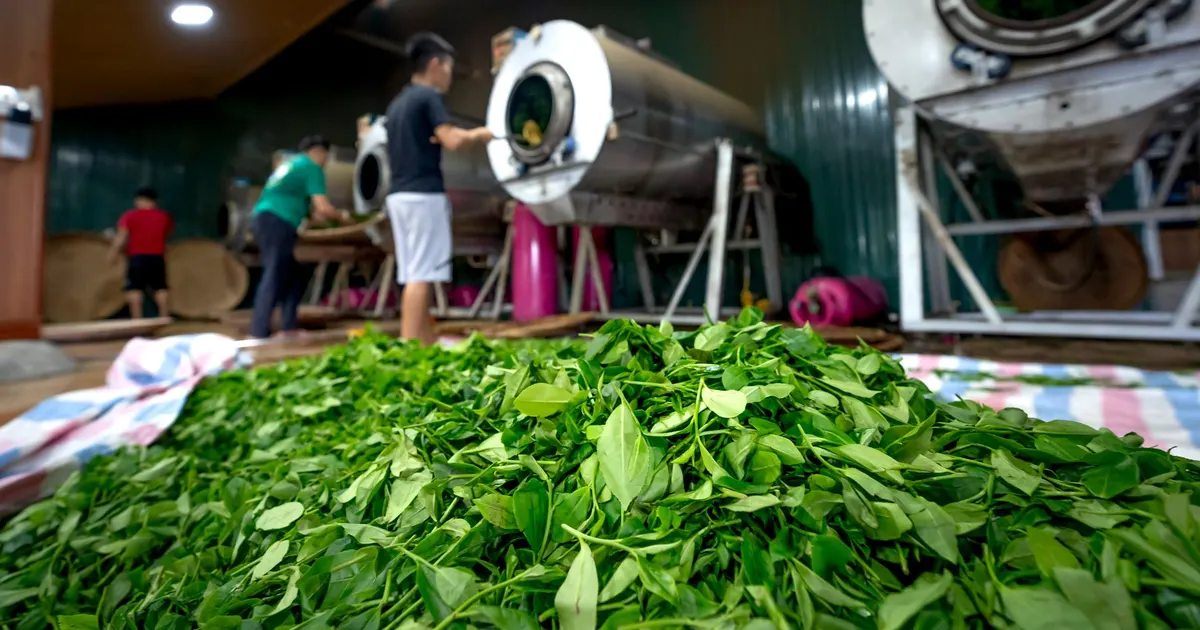
Every Vietnamese green tea lot starts as the same thing: young shoots from the same species of plant that gives black tea. What turns it into green tea is a short run of steps that remove water, stop the leaf from changing color and fix a shape. A buyer who knows those steps can read an offer sheet with more confidence, ask better questions about samples and spot gaps in a quote before they cost money.
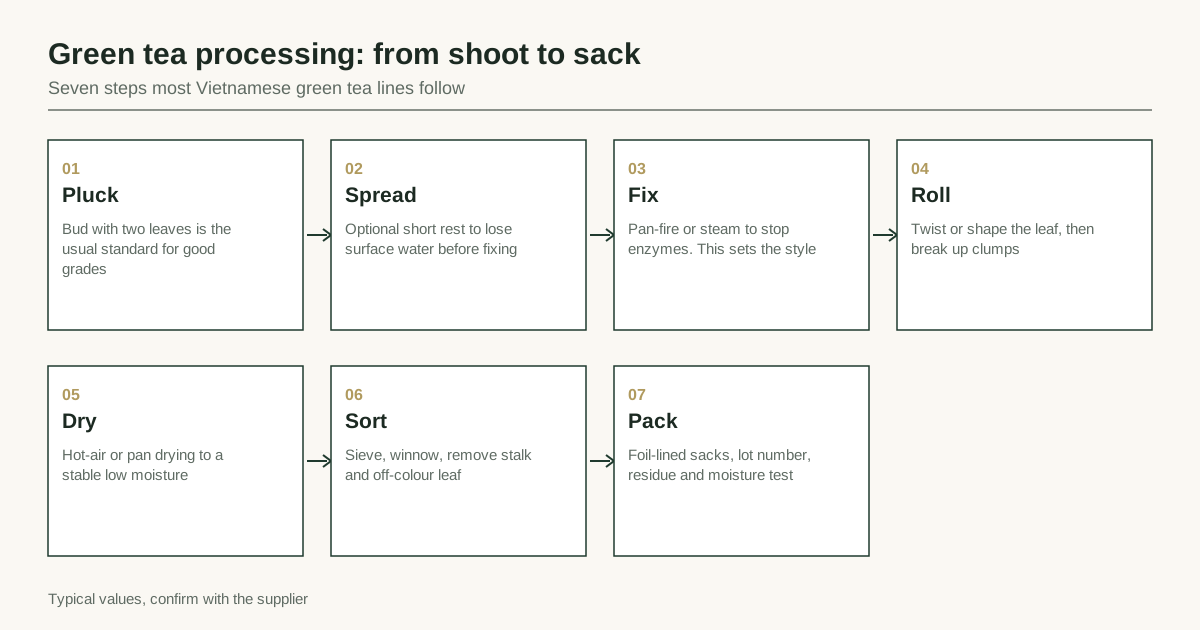
This guide walks through the sequence in the order a leaf experiences it. At each step it names what the step controls and what a buyer can write into a spec to protect that control. Details vary from one factory to the next and from one region to the next, so treat the figures as typical and confirm them with the supplier.
Plucking sets the ceiling
Quality is capped at the moment of plucking. A factory cannot add to what the leaf brought in. The common standard for good grades is one bud and two leaves, taken by hand. Larger-volume grades are often plucked more coarsely, with a bud and three or four leaves, or even cut with shears or a plucking machine. Coarser plucking gives more stalk and more mature leaf, which shows up later as a harsher cup and more sorting waste.
Timing matters as well. Leaf starts to heat and change within hours of being picked, so it needs to reach the factory quickly and be spread thin rather than left in a pile in the sun. Ask the supplier how long leaf waits between garden and fixing, and whether the lot comes from the supplier’s own gardens or from contracted farmers. Mixed sourcing is common and acceptable, but it changes how consistent a lot is from one batch to the next.
Spreading and short withering
Many lines spread fresh leaf on trays or floors for a short time before fixing. This loses some surface water and softens the leaf so it takes the next step without cracking. The rest period is brief for green tea, unlike black tea where withering is a long and deliberate stage. Too long a rest starts oxidation and dulls the color. Too short a rest leaves wet leaf that steams unevenly in the fixing drum.
Fixing: where the style is decided
Fixing, often called kill-green, is the heat treatment that stops the enzymes. It is the step that most clearly separates green tea from other teas, and it is the step that decides the style.
Two methods dominate. In pan-fired tea, leaf goes into a heated drum or a wide pan and is tossed for a few minutes. This gives a toasty, sweet note and is the traditional style of northern Vietnam. In steamed tea, the leaf passes through live steam for a short time, which gives a greener color and a grassier cup. Both methods work. The choice is a matter of end use, and our guide to steamed versus pan-fired green tea covers it in detail.
What to specify: write the style by name. A line that says “green tea” without a fixing method can be filled with either, and the two taste different enough that a blender will notice.
Rolling and shaping
After fixing, leaf is rolled. Rolling breaks cell walls so the flavor comes out in the cup, and it shapes the leaf: needles, twists, pellets or flat pieces depending on the machine and the style. Short rolling gives open leaf. Long rolling gives tight twists and more broken pieces. After a first roll the leaf forms clumps, so lines usually break them up and may roll again.
Shape affects what the buyer gets in the bag. Tight twist stores well and pours neatly in retail packs. Open leaf looks larger for the same weight. For bulk blending grades, shape matters less than consistency from lot to lot.
Drying: the step that decides shelf life
Drying removes the water that remains after rolling. Fresh leaf is mostly water, and finished tea needs to be very dry to keep. Typical finished moisture is about 3 to 5 percent when the leaf leaves the dryer, and a buyer’s spec often sets a maximum of 6 to 7 percent. Dryers may be hot-air machines, pan or drum dryers, or a combination, and many factories dry in two stages: a first pass at higher heat, a rest so moisture evens out inside the leaf, then a second pass at lower heat to finish.
Poor drying shows up late. A lot can look fine at the factory and then pick up moisture in a sack, which leads to flat flavor and in the worst case mold. The importer guide covers the wider buying picture. For this guide, the point is simple: write a moisture maximum into the spec and ask for the test result on the lot you are buying.
Sorting and grading
Dried leaf is a mixture. It holds whole leaf, broken pieces, stalk, dust and sometimes yellowed or burnt pieces. Sorting separates these. Typical equipment is a vibrating sieve for size, an air winnower for light fiber, a stalk remover and, at better-equipped factories, an optical color sorter. A magnet or metal detector at the end catches metal from machine wear.
The sorted grades are what the buyer orders: OP for long leaf, BOP for broken, fannings and dust for the small sizes. See the green tea grades page for how this site describes each. Because the same grade name can cover a range of leaf quality, a good spec also states the cut size or mesh range, the stalk limit and the share of fines allowed.
Final firing, blending and packing
Some factories give the sorted tea a last light firing to drive off any moisture picked up during sorting and to deepen flavor. Then lots are blended to a standard, sampled for testing and packed. Bulk green tea normally goes into foil-lined paper sacks of 25 to 50 kg. Retail or private-label packing is done on separate packing lines and usually adds cost and lead time.
A lot number printed on every sack ties the tea to its moisture result, its residue report and its production date. Ask for it. It is the cheapest piece of traceability a buyer can get. For more on the residue side, see our guide to pesticide residue limits for green tea.
Scale and the small factory
Processing steps are the same in a small cooperative and in a large plant, but the equipment and the control are different. A small cooperative may fix leaf in a pan by hand, roll on a simple machine and dry on trays or in a small dryer. A large factory may run a continuous line with drum fixers, rolling machines, multi-stage dryers and sorting equipment. Small units give hand-finished lots with strong character and limited volume. Large units give steadier volume and tighter control, but they are less flexible on small premium lots.
Neither is better in every case. Choose by the lot you want, the volume you need and the records the supplier can show. A small cooperative with careful records can supply a very good lot. A large factory with sloppy records can ship a poor one. Ask for the same evidence from both: moisture results, residue reports, lot numbers and a clear description of each step.
Which step controls which spec line
| Step | Controls | What to write into the spec |
|---|---|---|
| Plucking | Leaf maturity, stalk share | Bud and leaf standard, stalk limit |
| Fixing | Style and color | Pan-fired or steamed |
| Rolling | Leaf shape, break rate | Needle, twist or cut |
| Drying | Moisture, shelf life | Moisture maximum, test method |
| Sorting | Grade, purity | Grade, cut size, fines limit |
| Packing | Traceability | Sack type, net weight, lot number |
Questions to ask a supplier about their line
You do not need to visit a factory to learn a lot from a few written questions. Ask which fixing method the line uses and whether the same factory runs both. Ask what the typical moisture is at the end of drying and what the tested moisture was on the sample lot. Ask whether leaf is plucked by hand or by machine for the grade you want. Ask what sorting equipment the factory runs and who tests residues. Reply speed and detail are themselves useful signals: a supplier who answers in specifics usually runs a tidy line.
This site is an independent matching service. We do not own factories and we do not run quality inspections on suppliers. You and the supplier work together on samples, testing and any third-party inspection you want to arrange.
Next step
If you know the style and grade you need, put it in a written spec and send it through the RFQ form. We review each request and introduce up to 3 matched Vietnamese suppliers within 24 business hours. The service is free for buyers.
Frequently asked questions
What is the difference between green tea and black tea processing?
Green tea is heated soon after plucking to stop the enzymes that cause oxidation, so the leaf stays green. Black tea is withered, rolled and left to oxidize before it is dried.
Which step has the most effect on the final cup?
Fixing sets the style, but plucking standard and drying control have just as much effect on quality. A well fixed tea that is dried unevenly or left too moist will still fail in the buyer's warehouse.
Should an RFQ name the process?
Yes. Write the style you want, for example pan-fired or steamed, plus the moisture limit and the sorted grade. The supplier then knows which line to use and which lots to offer.
Sources
- Wikipedia: Green tea
- ISO 11287: Green tea, definition and basic requirements