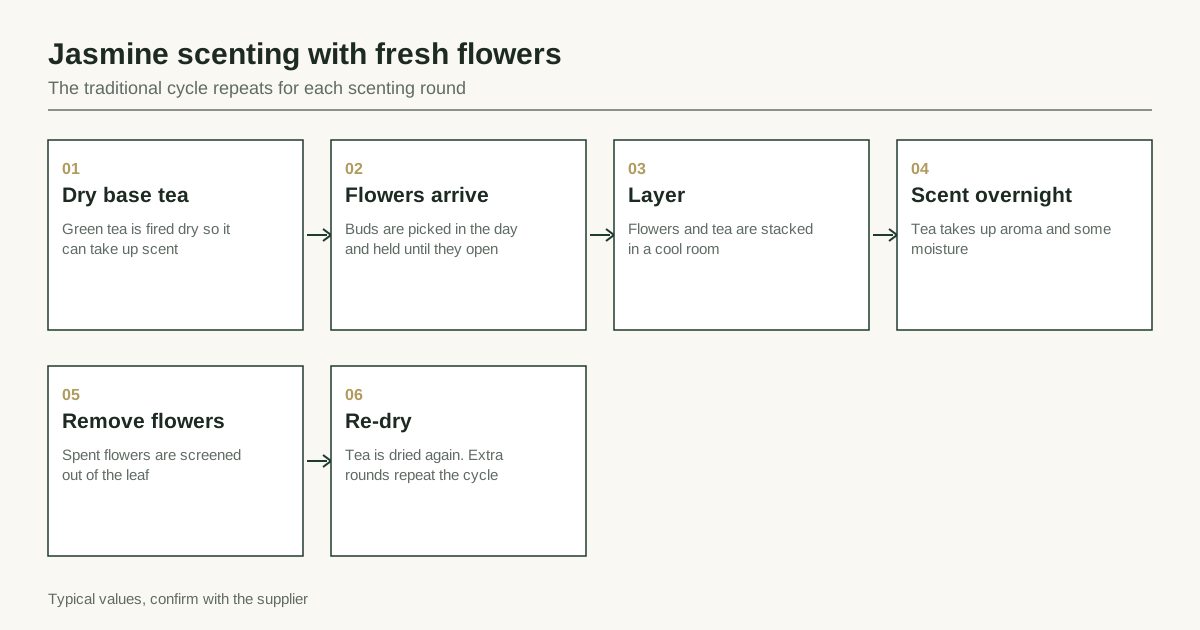
- Traditional jasmine tea takes up its aroma from fresh blossoms layered with dry green tea over repeated rounds, then the tea is dried again.
- Added-flavor jasmine uses jasmine flavoring on plain green tea. It costs less and is easier to scale, but it must be labeled differently.
- The price gap comes from flowers, labor and re-drying, so ask how many scenting rounds a lot received and whether flavor was added.
Jasmine green tea is one of the best known scented teas in the world and one of the easiest to misdescribe. Two lots on a price list can both read “jasmine green tea” and yet be made in completely different ways, with very different costs and very different labels. A buyer who understands the two methods can sort a real quote from a vague one in a few minutes.
This guide describes the traditional layering method, the added-flavor method and the in-between products, then lists the questions that separate them. Our price guide shows where jasmine sits in the wider price picture.
The traditional method: layering with fresh blossoms
The classic jasmine process uses the flowers of Arabian jasmine, usually Jasminum sambac. The blossoms are picked as closed buds in the afternoon and held until they begin to open in the evening. As they open, they release the aroma that tea can capture.
The tea itself is a finished green tea, dried to a low moisture, because dry leaf takes up scent readily. Workers or machines stack flowers and tea in layers, or mix them in a heap, in a cool room. Over several hours the tea absorbs aroma and also some moisture and warmth from the flowers. After scenting, the spent flowers are screened out and the tea is dried again to bring the moisture back down. A single cycle of layering, resting and re-drying is one scenting round.
Better grades go through several rounds, each with a fresh batch of flowers. More rounds give a deeper and longer-lasting aroma but cost more, because every round needs flowers, labor, space and another pass through the dryer. The number of rounds is a usual way for suppliers to describe grade, although naming schemes differ and buyers should ask for the count in plain numbers.
Added flavor: the other approach
The second approach starts with plain green tea and adds a jasmine flavoring. The flavoring may be a natural jasmine extract, a natural flavoring made to taste like jasmine, or a nature-identical or artificial blend. It is sprayed or mixed onto the leaf, then the tea is dried or rested.
This method is fast and cheap to run, and it gives a very consistent result from one batch to the next, which some packers like for large-volume bags. It also lets a factory scent tea out of season, when flowers are unavailable. The trade-off is flavor depth. Added flavor often smells strong in the bag and fades quickly in the cup, while fresh-scented tea tends to hold its aroma through the infusion.
Neither method is wrong. Problems come when the label does not match the method. In many markets, a tea scented with added flavor has to say so, and in the EU the ingredient list must declare the flavoring. Check the rules of your destination market, since descriptions like “natural” and “jasmine” are regulated in different ways.
In-between products
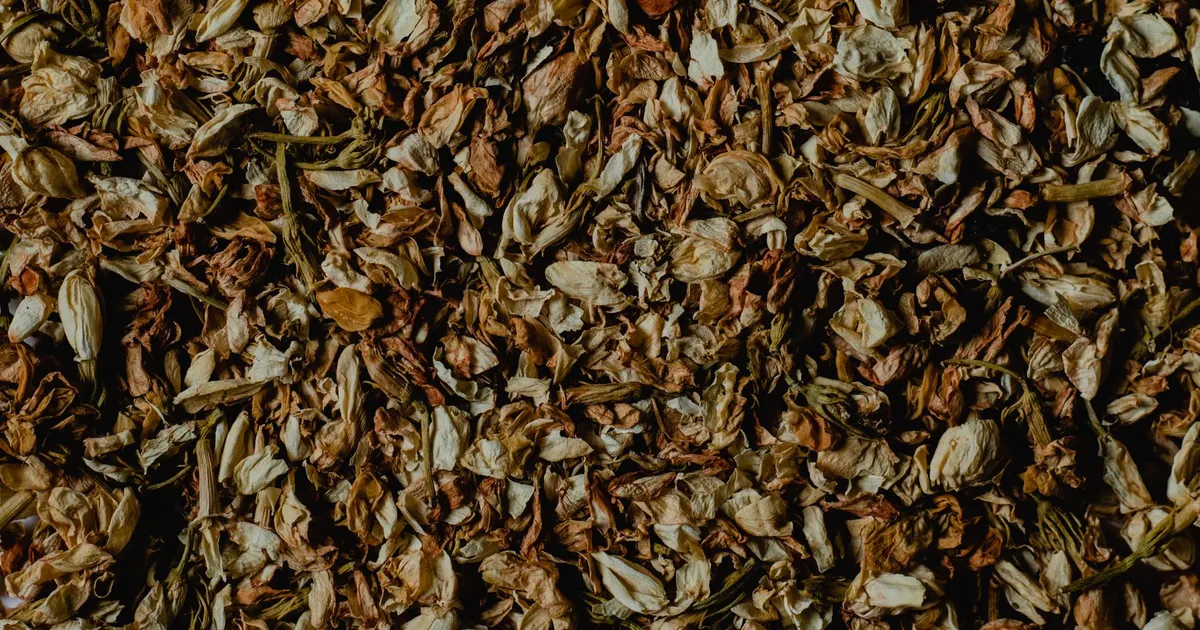
Some lots mix methods. A common one is a fresh-scented tea with a short scenting history topped up with a little flavoring to meet a target aroma. Another is plain green tea with dried jasmine blossoms added for looks. The dried blossoms are visually appealing and fine as decoration, but they carry almost no scent into the cup.
Ask the supplier to state which of these a lot is, in writing, and to list every ingredient. An honest in-between product is perfectly saleable when it is described correctly.
What drives the price gap
Real flower scenting carries costs that flavoring avoids:
- Flowers: jasmine blossom is a seasonal crop picked by hand and priced by the kilo.
- Labor: layering, turning and screening are manual or semi-manual.
- Time and space: tea rests for hours in each round.
- Energy: every round ends with a re-drying pass.
- Yield: handling losses add up as the leaf is stacked, screened and dried repeatedly.
A supplier selling multi-round scented tea at a price close to plain green tea needs to explain how. Our pricing article covers how to compare quotes line by line.
Base tea matters too
Jasmine tea is only as good as the green tea under it. Base tea should be clean and dry, with a mild flavor so that the scent leads. A strongly toasted or grassy base clashes with jasmine. Many producers use a mild steamed or pan-fired green leaf for this reason. If you plan to use the tea in a ready-to-drink drink or bubble tea shop, the base also needs to stand up to milk and ice, so brew a test cup with your own milk and ice before you commit.
Seasons and flower supply
Jasmine blooms in warm months, and the main scenting season follows the flower supply. Out of season, factories either stop fresh scenting or rely on stored flowers and added flavoring. When you plan a contract for fresh-scented tea, ask which months the factory scents and how much it can make in that window. A buyer who needs year-round supply of one lot should think about placing a large order in season and storing the tea in sealed packs, or about specifying a flavored product for the off months and labeling it accordingly.
Flower supply also moves price. A wet or cool season reduces flower yield, and the price of blossoms rises while tea makers compete for them. Quotes for scented tea therefore carry a short validity period. Ask for the date a quote expires and what happens if flower prices change before you confirm.
Other scented teas
Jasmine is the best known scented tea, but Vietnamese makers also scent green tea with other flowers. The same questions apply to every one of them: which flower, how many rounds, fresh or added flavor, and what is the base tea. Do not assume the jasmine answers carry over. Each flower has its own season, its own price and its own flavor behavior.
Reading the sample
When the sample arrives, brew it twice. Brew once at a normal strength and once at double strength with water just off the boil. Smell the dry leaf first, then the wet leaf, then taste the liquor. Fresh-scented tea usually smells soft and rounded in the dry leaf, then opens in the wet leaf and in the cup. Added flavor often hits strongly in the dry leaf and fades. Compare two or three samples side by side with the same dose, the same water and the same time, so that you are comparing the tea and not the brewing. Write down the result and keep a sealed portion of the sample, so that you can compare later lots against the same reference.
Comparison of the two methods
| Feature | Fresh flower layering | Added flavor |
|---|---|---|
| Aroma source | Jasmine blossoms | Flavoring |
| Process time | Several rounds, each with re-drying | One short application |
| Aroma in the cup | Holds through the infusion | Often fades sooner |
| Cost | Higher | Lower |
| Seasonality | Limited by flower supply | Year round |
| Labeling | Scented with jasmine flowers | Must declare flavoring |
Questions to ask a supplier
Ask whether the lot is scented with fresh flowers, flavored or both. Ask how many scenting rounds it received and in which months the scenting took place. Ask where the flowers come from and how many kilos of flowers go into a kilo of tea, since a very low ratio suggests light scenting. Ask what the base tea is, and ask whether dried blossoms were added back. Ask for the moisture of the finished tea, because tea that has been scented and not dried properly can pick up mold in transit.
Finally, ask for a residue report on the finished product. Both the leaf and the flowers can carry residues, and a clean base tea does not guarantee a clean scented tea.
Packing and storage
Scented tea gives off aroma and also absorbs smells from its surroundings. Pack it in sealed foil-lined bags and keep it away from other goods in the container. Do not mix scented and unscented teas in the same pallet if you can avoid it. Store cool, dry and dark, and plan to use the tea within the shelf life the supplier states, since scent fades with time even in good packing.
Next step
State the method you want, the number of scenting rounds and whether flavoring is acceptable, then send the spec through the RFQ form. We introduce up to 3 Vietnamese suppliers within 24 business hours, and you agree samples and paperwork directly with them. The service is free for buyers.
Frequently asked questions
How can I tell fresh-scented jasmine from flavored jasmine?
Smell and taste can hint at it, but the reliable answer is paper. Ask the supplier to state the method in writing, list every ingredient and say how many scenting rounds were used. Compare against a sample you have approved.
Are the flowers in the tea part of the scent?
No. The flowers that scent the tea are usually screened out afterwards. Dried blossoms seen in the finished tea are often added back for appearance and add little aroma.
Does jasmine tea need a different residue test?
The tea and the flowers both count. Ask for a residue report on the finished product and ask how the flower supply is controlled.